2024 London Whisky Show Mainstage Festival Picks!

For the 2024 Whisky Show, a new approach to the Mainstage sessions was introduced. Rather than be in the midst of the chaos and cacophony of the show floor, a room was set aside and one had to book a seat in advance. It was exactly like a masterclass – except it was included in the standard ticket price. 

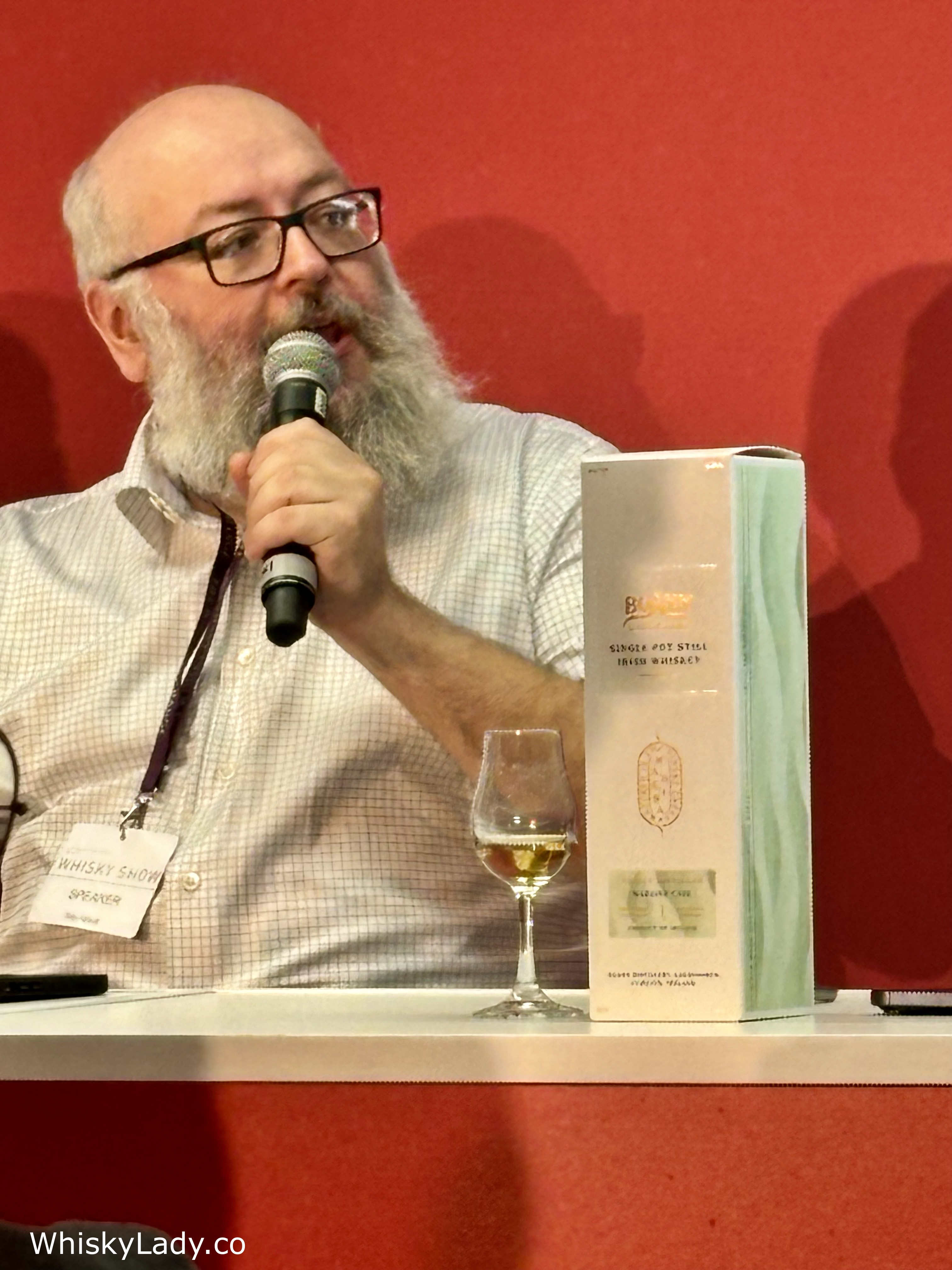
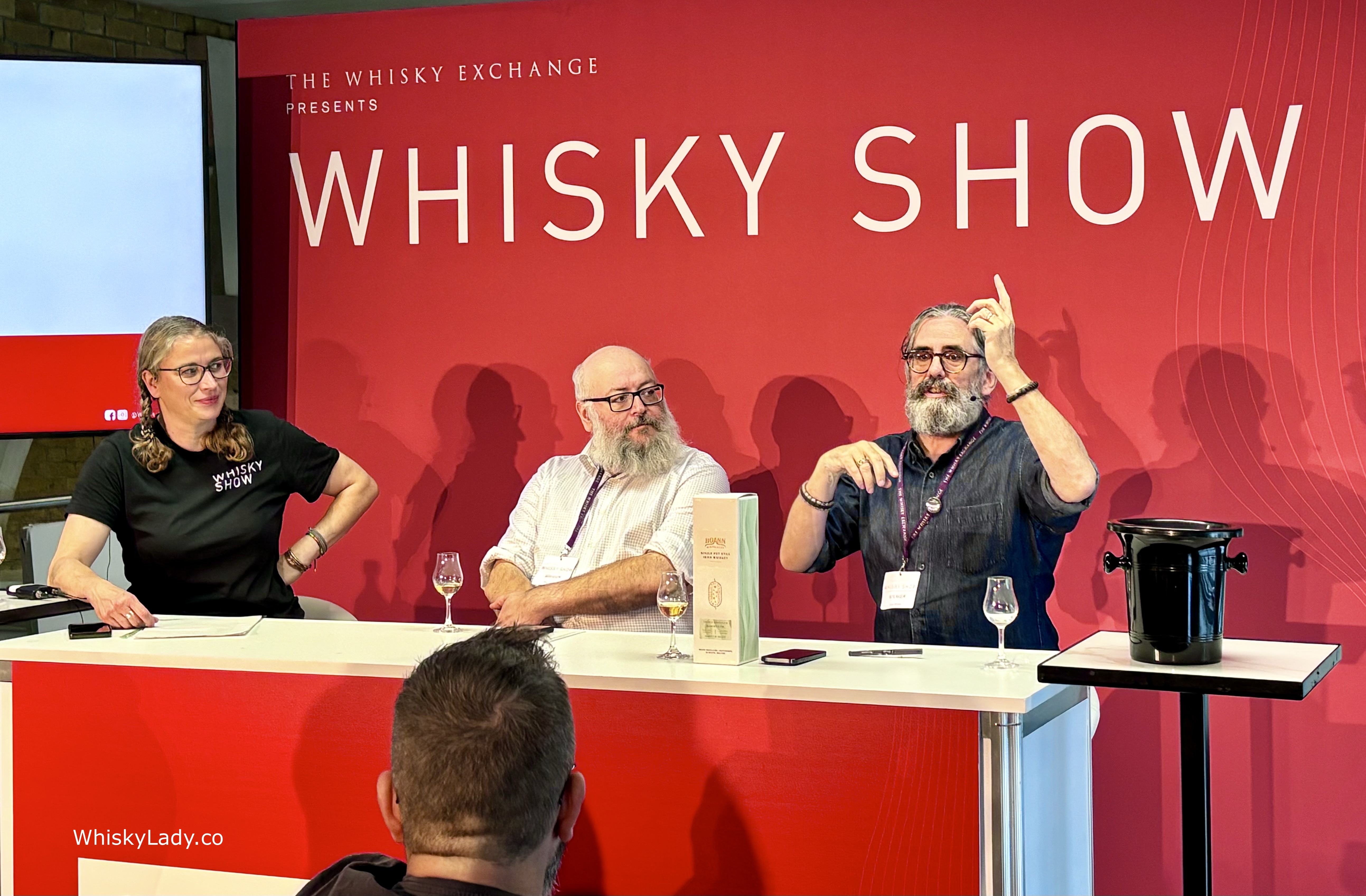
I signed us up for Sunday’s Festival Picks with Dawn Davies and Billy Abbott from The Whisky Exchange with Dave Broom. 

As Dave was double booked, his festival pick was where our tales began. 

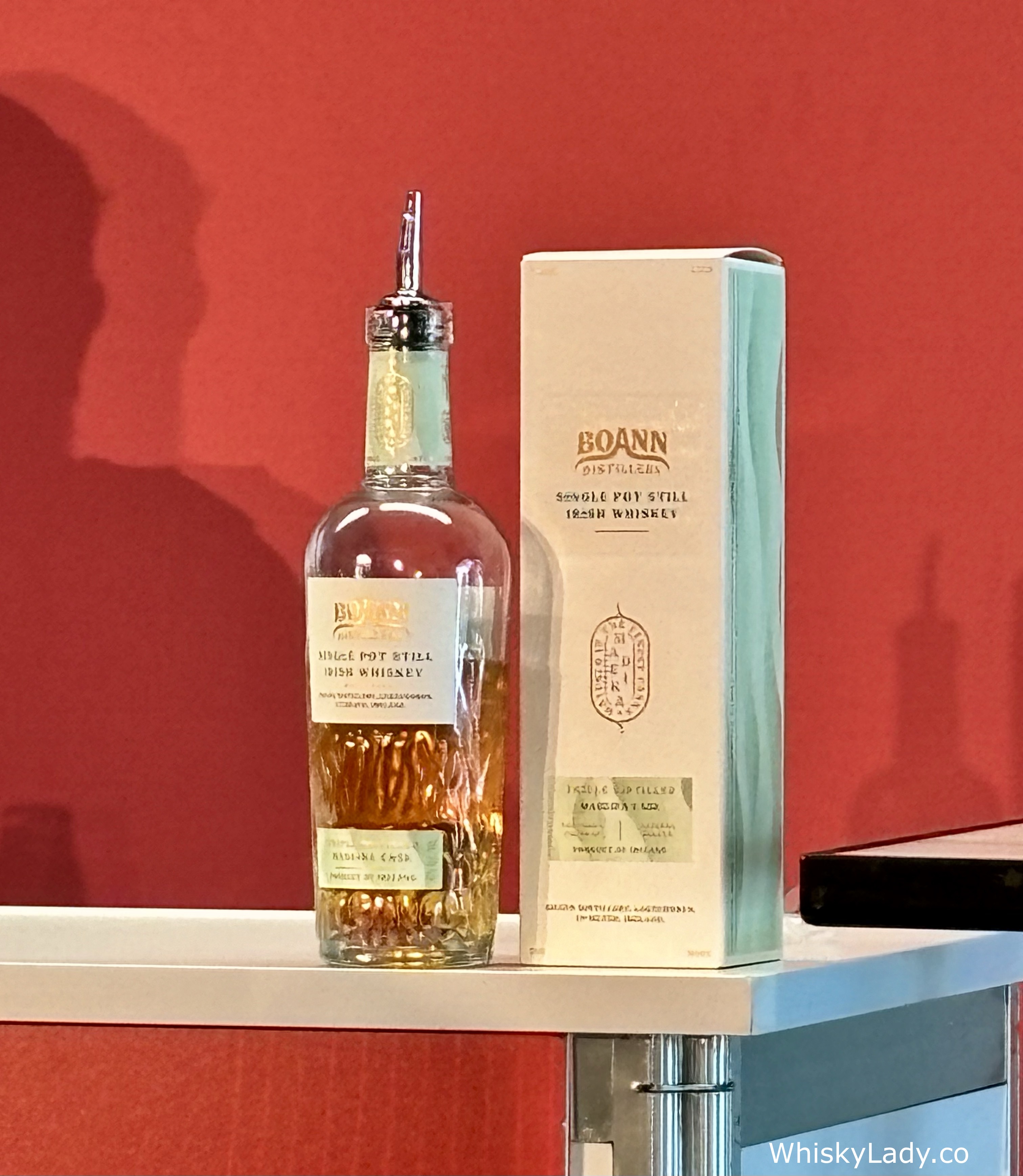
Boann Irish Pot Still Madeira Cask 47%

  • Nose – Light, fruity, young and fresh, the sour mash shifted into a lovely honeydew melon then cantaloupe
  • Palate – Oily with spice, creamy oats, and candyfloss, with the madeira cask bringing a sweet fruit and nuts element
  • Finish – Lingers and lingers

Talk turned to slightly ribald comments about the bottle being “ribbed” for ones pleasure… Then to discussions of nanotechnology, reverse chill condensation, increased copper contact, inverse temperature, blend of malted and unmalted barley, single pot still and more…. 

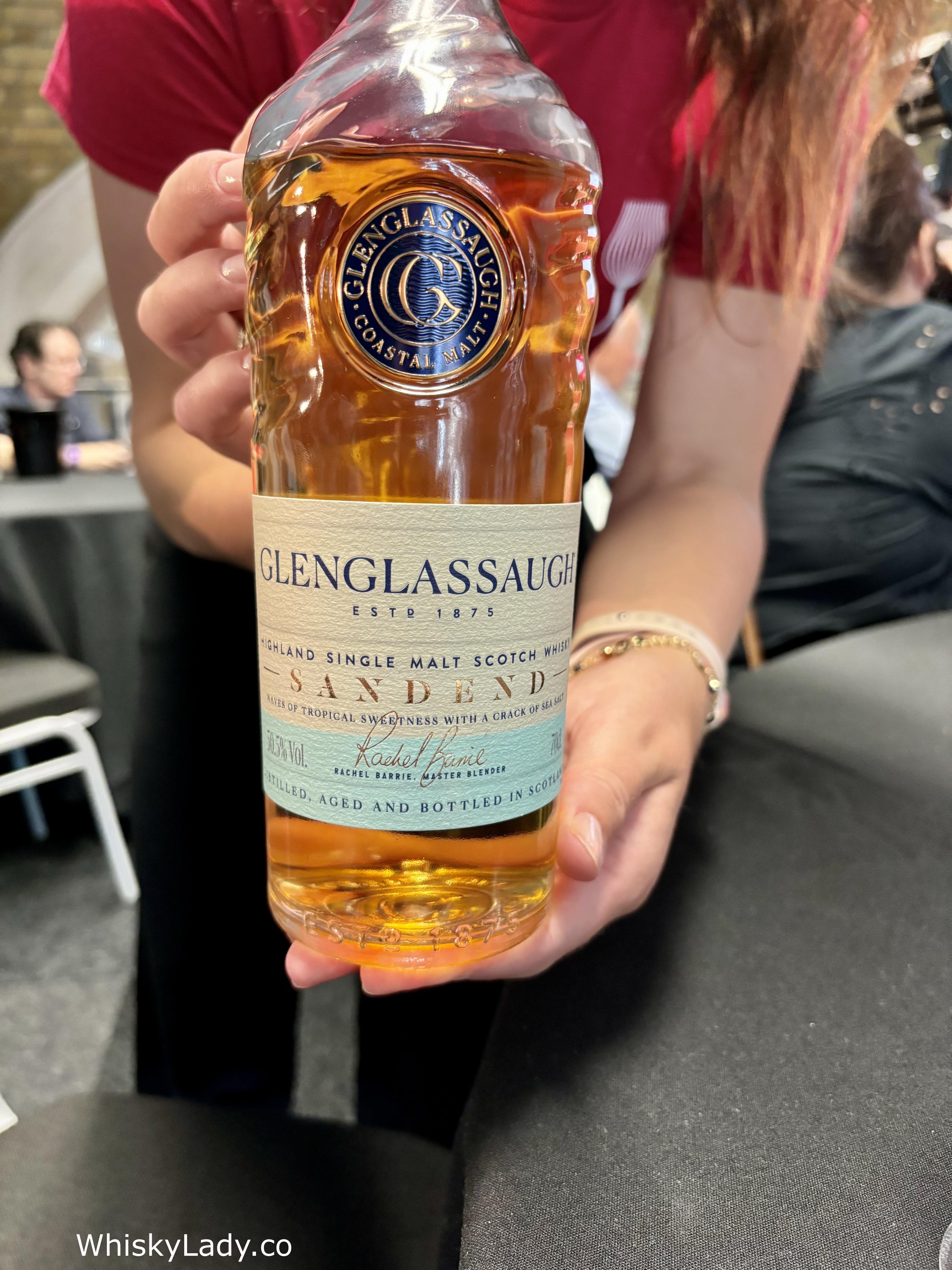
Glenglassaugh Sandend 50.5% GBP 54

Billy shared how he was highly impressed by a Chichibu, however as it had sold out, turned his attention back to Scotland – selecting a new expression from Gleglassaugh.

I’ve had a mixed experience with Glenglassaugh – the early days were a bit bumpy however they have indeed improved significantly. Still a far cry from the original which is something to experience if you have a chance!

Again another ripped bottle! 

  • Nose – Off to a promising start! Fruity – think orchard fruits, delicate and sweet, chased with honey, opens up more over time… revealing grapefruit, with sea salt
  • Palate – Spice and nice with substance, salted caramel, quite mineral, a bit rough even, then mellows out and becomes more accessible
  • Finish – Companionable spice

Billy remarked how this is an affordable dram he pronounced also has high “drinkability.” And how he sees a clear continued space in the industry for more traditional-styled whisky like this one.  

Here’s what they have to say:

Glenglassaugh Sandend is inspired by the crescent beach of Sandend Bay where the distillery resides. Enriched in bourbon, sherry and manzanilla casks, over time the lush flavour of Glenglassaugh Sandend brightens into waves of tropical sweetness, infused with a crack of sea salt.

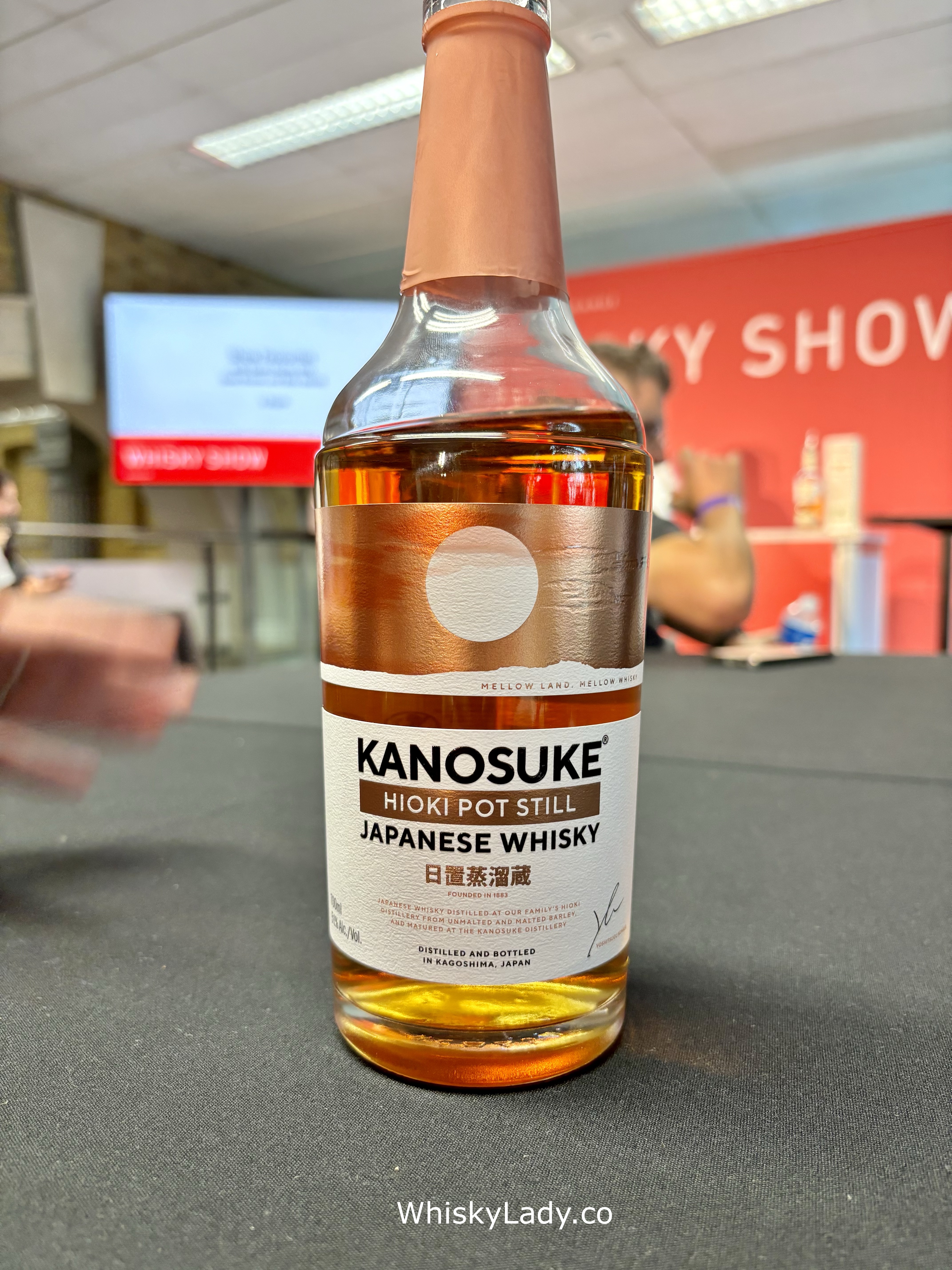
Kanosuke Hioki Pot Still 51% ~GBP 94

We closed with Dawn’s pick from Japan. Kanosuke have two distilleries – Hioki is the one responsible for Mellowed Kozuru shochu. 

  • Nose – Sour cherries, cranberries, bright, beautiful, sweet polish
  • Palate – Very oak forward, varnish, very distinctive and different

Dawn shared that what makes this whisky so singular is that it is actually produced in a Sochu pot still – hence it is a bit of an un-whisky like whisky. She described the result as being a cross between Irish and American though Japanese! 

The selection of whiskies was intended to be both available and more accessible. Everyone can pick as their favourite an outrageously rare dram. Finding one that stands out which is affordable takes a different approach.

I’m a big fan of this new format. We can really enjoy the “Mainstage” aka masterclass and will certainly be checking out which ones we can catch in 2025!

If you don’t want to miss a post, why not follow Whisky Lady on:

Nurnberg Whisky Explorer’s 2025 kick off!

In 2025, our Nurnberg Whisky Explorers group abandoned all pretense of mostly monthly gatherings and opted for the more realistic goal of quarterly connects.

Our first session had no designated theme – the choice was entirely up to our four contributors. The result was a terrific combination of distinct drams, each bringing their unique voice to the chorus, with no competition or unfavourable comparisons.

So what did we explore?

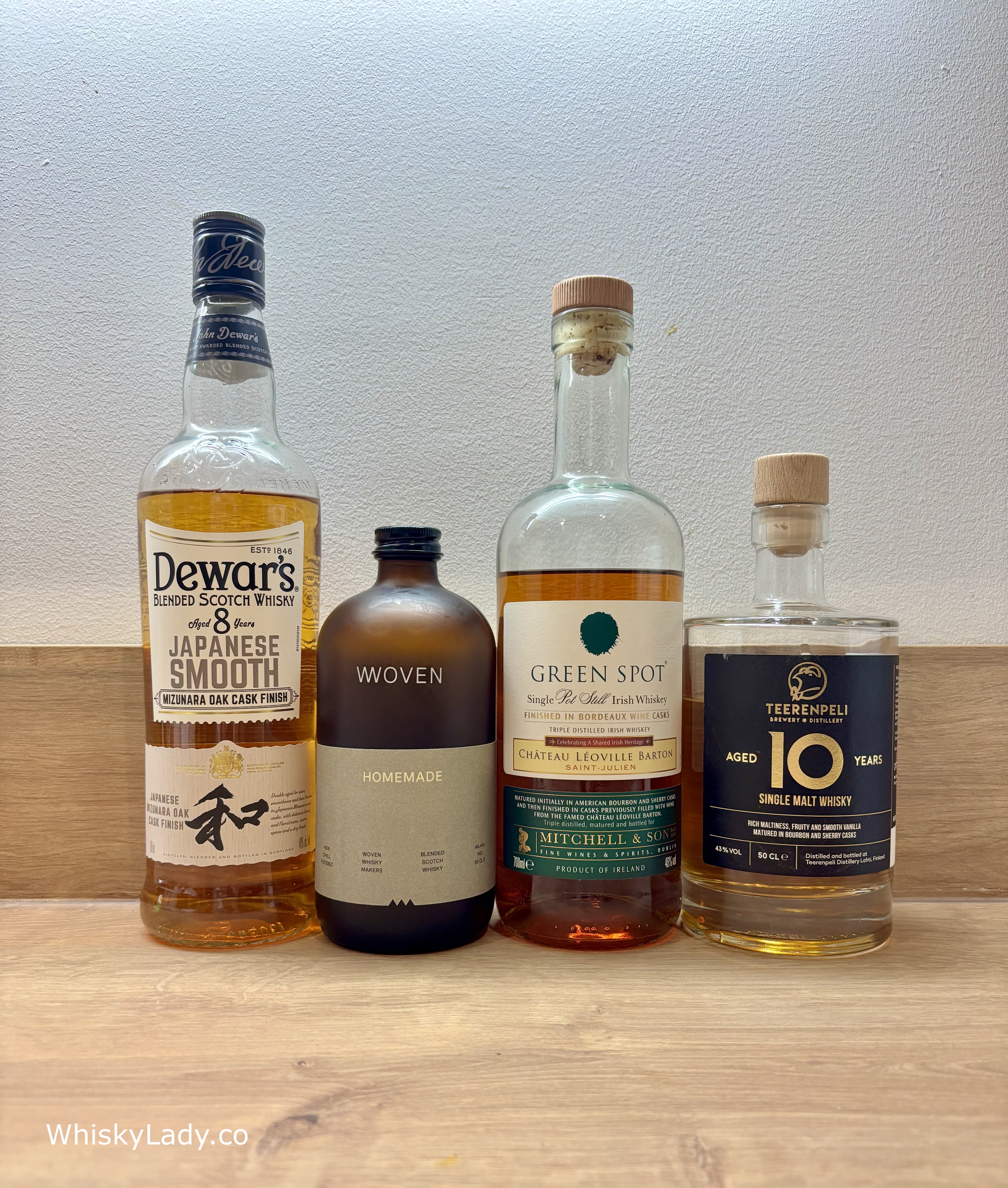
  • Dewar’s 8 year Japanese Smooth 43%
  • Woven Homemade 46.4%
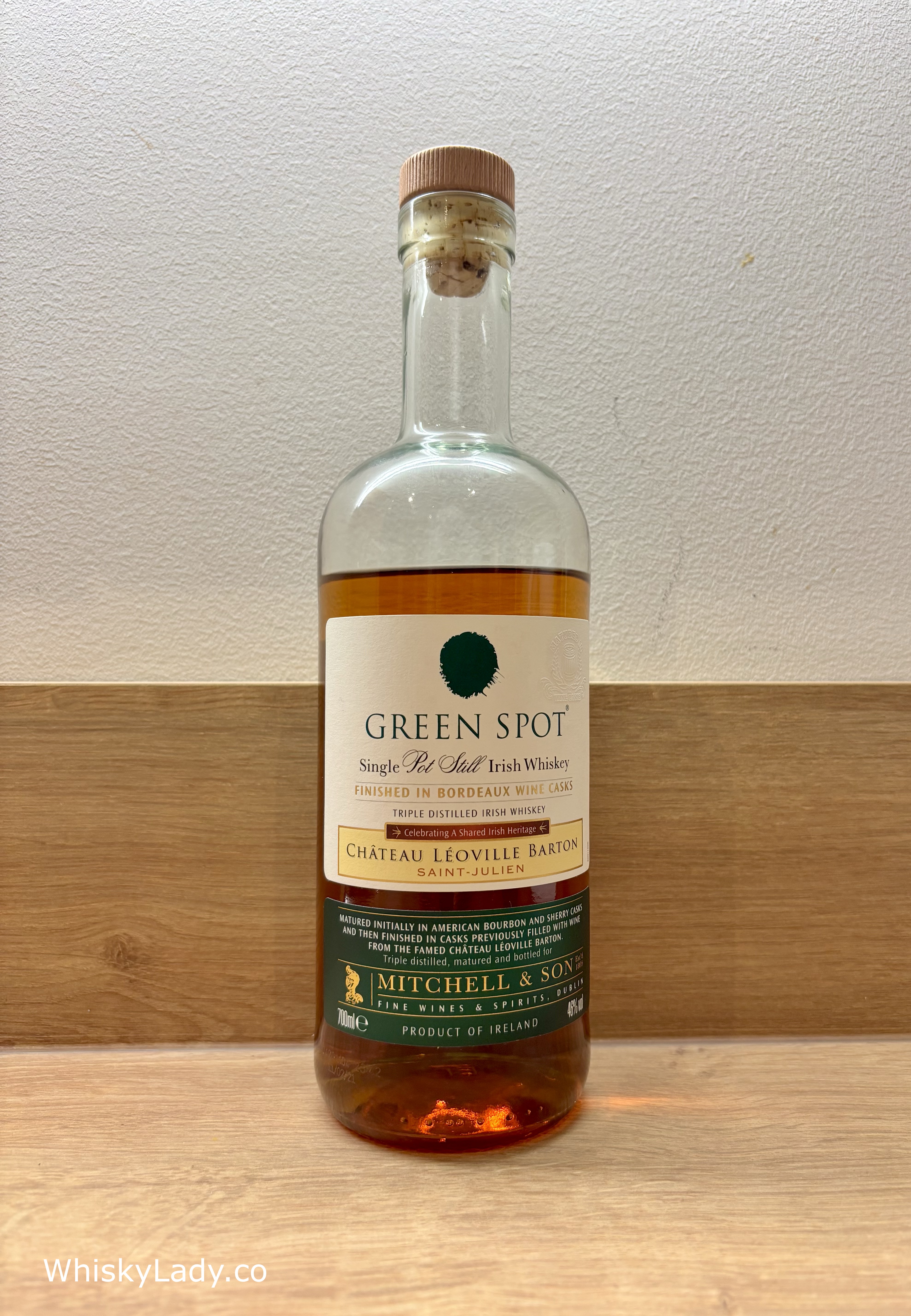
  • Green Spot Château Léoville Barton Bordeuax Finish 46%
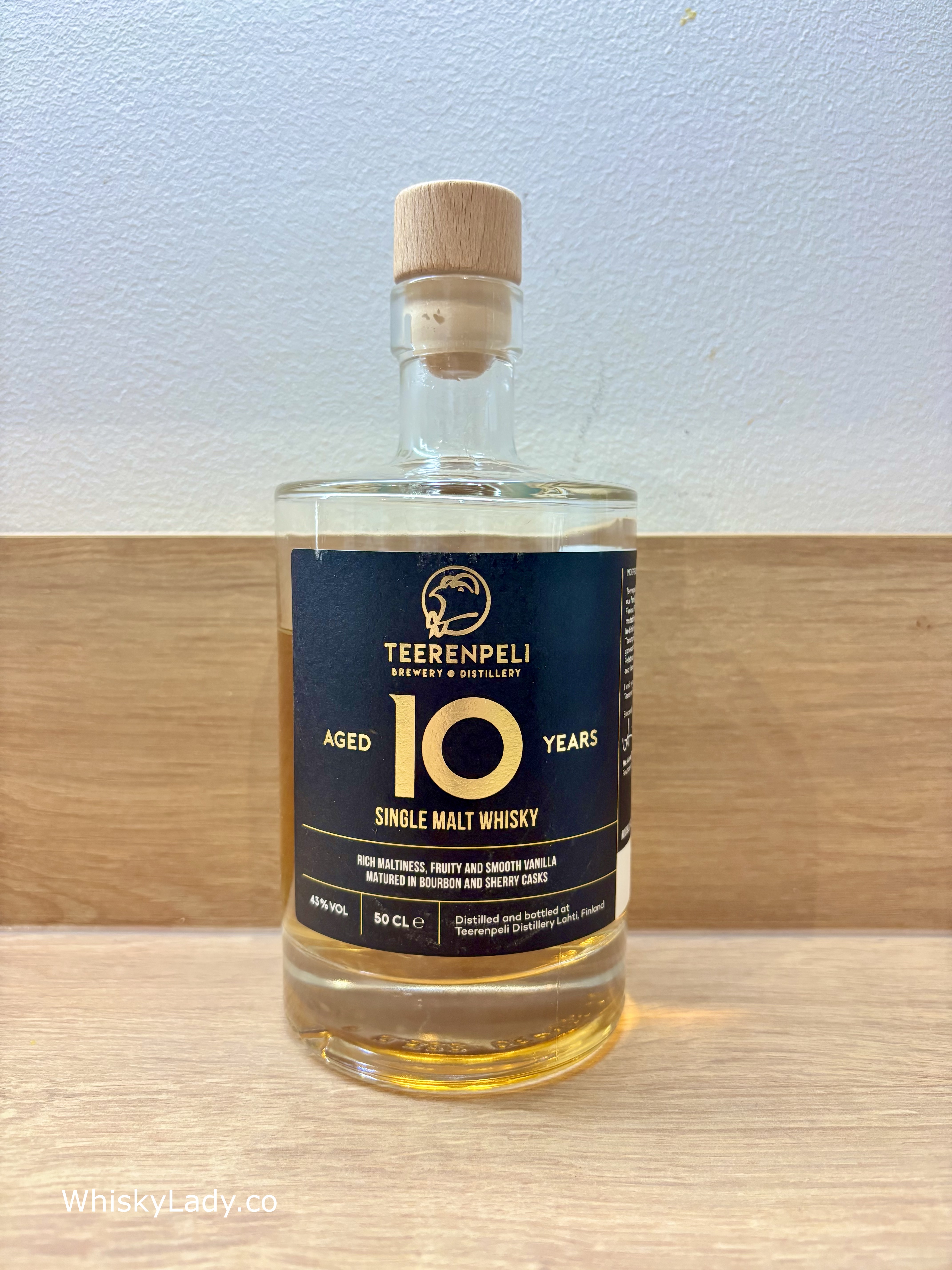
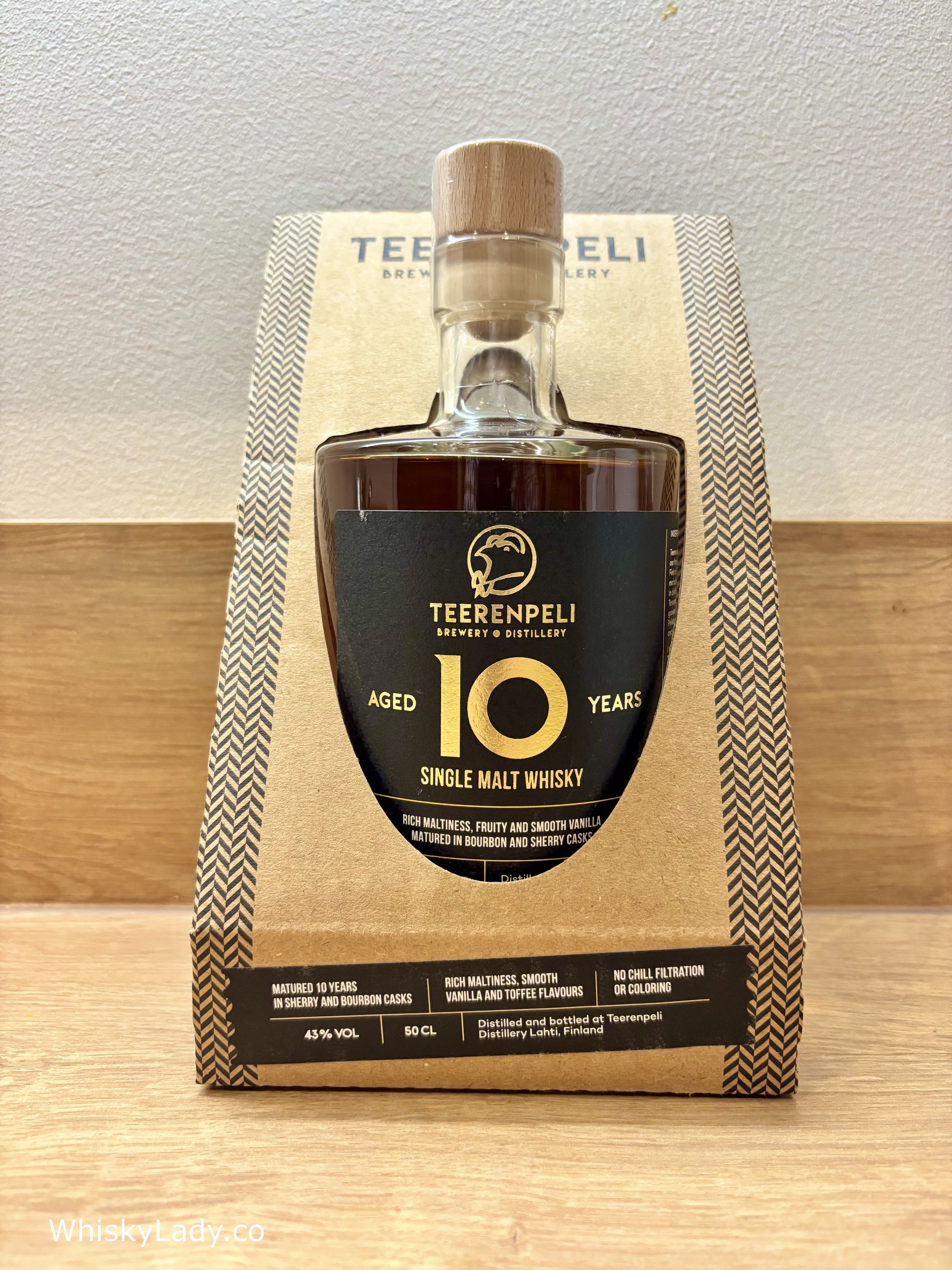
  • Teerenpeli 10 year 43%

Interestingly, three were blends – two of Scottish origin and one Irish – closing with a special Finnish single malt. For me, it was an evening of mostly revisits – albeit nearly a decade later! Which made it such fun to experience anew!

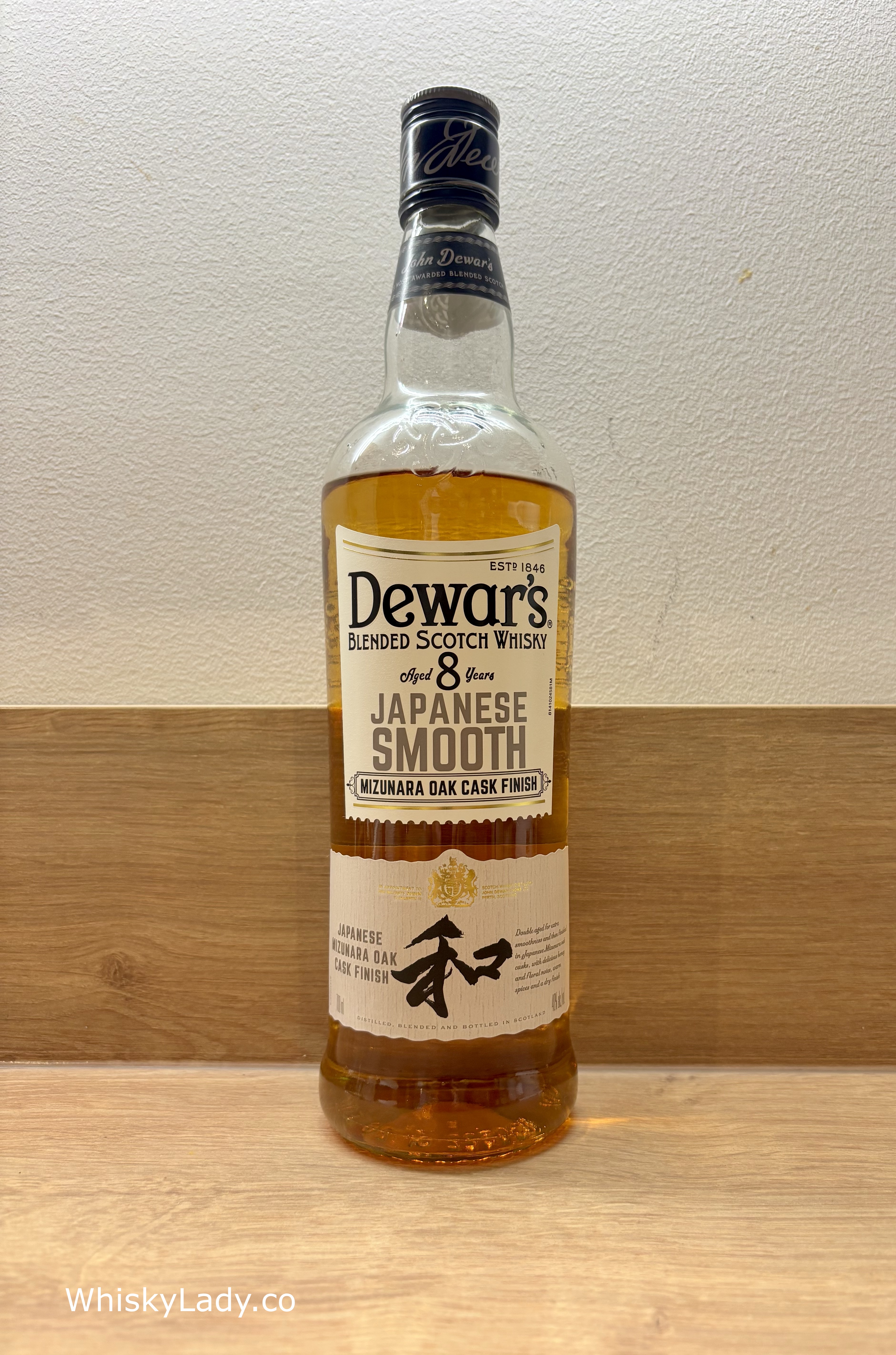
Dewar’s 8 year Japanese Smooth Mizunara Wood Finish 43% ~Eur 21

Dewar’s is such a well-known blend. And yet, joining the standards are a few expressions that play with different elements – enter the Dewar’s finished in Japanese Mizunara Wood. What did we find?

  • Nose – Warm, honey with a hint of vanilla, shifting into a fresh citrus
  • Palate – It had a prickly spice, oak, a dash of sweet dry spices like cinnamon, and lots of vanilla
  • Finish – Hint of wax or a touch of salt depending on who you asked, quite dry

With a name like “Japanese Smooth”, we anticipated something silky soft with a nuanced floral element, maybe even a bit of light fruit? The mizunara wood finish certainly made this an interesting Dewar’s expression, however, was it floral or fruity? Not so much.

Setting aside preconceived notions, it was just the right way to start our evening and well worth trying. Even with the revisit, after sampling the other three, it held its own.

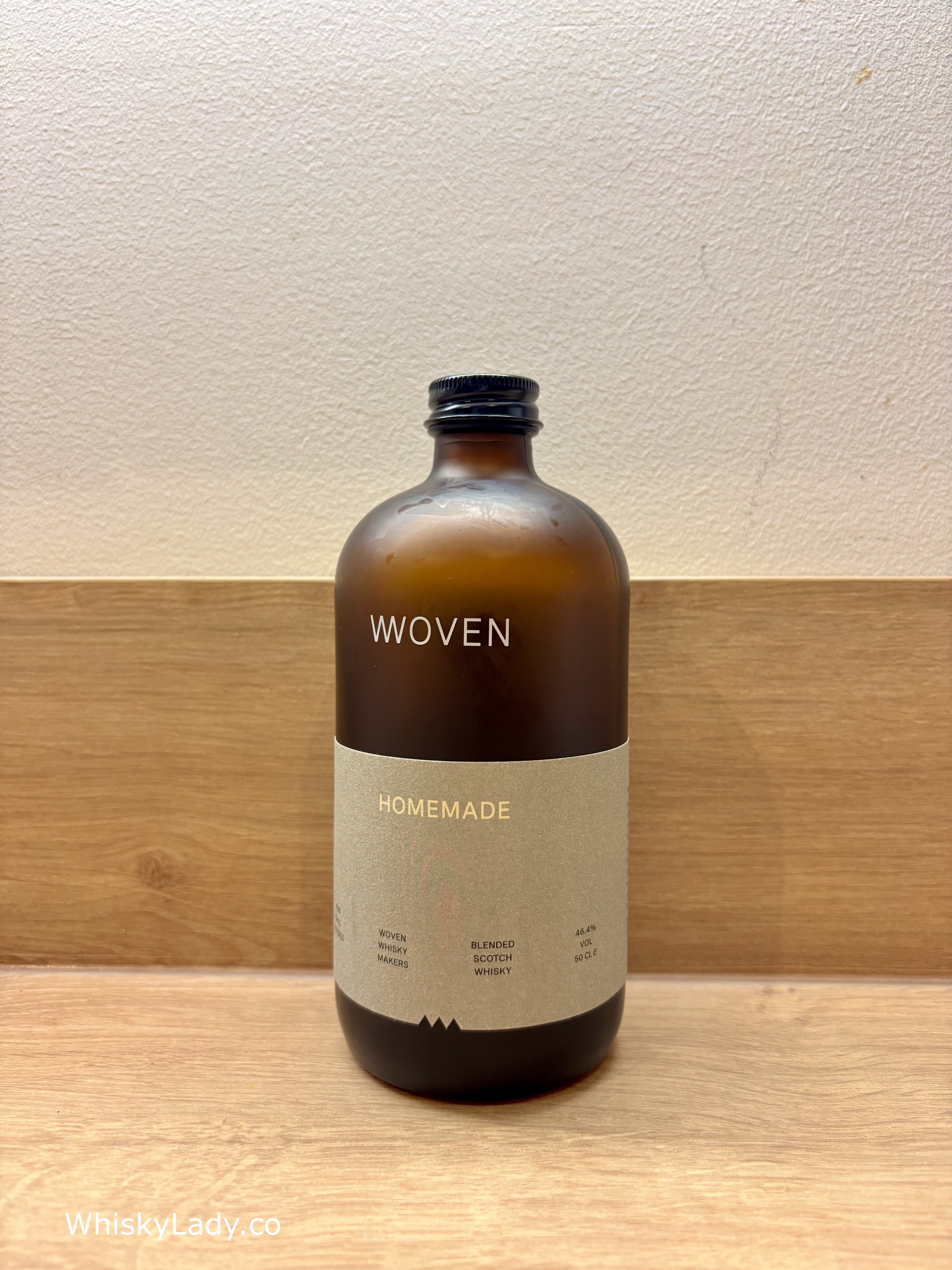
Woven Homemade 46.4% ~Eur 38 8120 bottles (500 ml)

Imagine entering an apothecary shop… or bringing together a couple of chemist with a wild array of options.. all about crafting an interesting experience. That’s what you can expect with a Woven whisky blend.

  • Nose – Began with lemon custard and butter, warm biscuits, green apple, slightly sour apple sauce
  • Palate – Start creamy, buttery, some rosehip, nutty oil, then shifts into becoming very dry
  • Finish – From lemon drop candy, to nutty butter, increasingly bitter over time

Very distinctive and unique. One described it as “effervescent” reminding him of a children’s fizzy medicine – brausetabletten. For all of us, it was remarkable how its character changed, Really quite interesting from an Apple martini to creamy nutty to dry and bitter. This was no “easy” blend – instead, it challenged us – in a good way. With the revisit, it also retained its specific character.

What more do we know? Only that it is a blend of two Speyside whiskies  (41.78% and 29.99%) and a Lowland grain (28.23%), likely blended 14 May 2023 with 70 days “marrying” period. In character, it was evaluated by the folks at Woven as somewhere between Balanced and Complex. And yes – we appreciated the other options – Fresh and Exploratory. And finally, it has a clear “nod” to BNJ – a bit of a cult whisky blend in some circles that also boasts a high malt portion.

You can find more details here: Woven Homemade.

Green Spot Château Léoville Barton Bordeaux Wine Finish 46% ~Eur 55

We then moved from Scotland to Ireland. This was no ordinary Green Spot! A year ago, our contributor brought the standard edition — a pleasure to revisit! This time, it was the Green Spot expression finished in Bordeaux casks…

  • Nose – It began with melted caramel, tobacco leaf, and tannins, warm and heavy, the longer it remained in the glass, the more prominent the brown sugar aroma became
  • Palate – Very pronounced red wine influence! There was an interesting undertone of oak and tannins, rich, rolling around in your mouth
  • Finish – Long finish, dry

The red wine cask was so prominent, that we speculated they must have finished in a rather “wet” cask, leaving a fair amount of Château Léoville Barton to mingle with the whiskey. Or as one whisky aficionado quipped “This is how wine should taste!”

Truth be told, as we tasted, I didn’t immediately remember being introduced to this expression some six years earlier at an Irish evening in Mumbai! This Is why it is such fun to have random evenings – you never know what will turn up and with it a fresh perspective too.

Teerenpeli 10 year 43% ~Eur 73

For me, the true treat of the night was an opportunity to revisit the Teerenpeli 10 year. It captivated my fancy in 2016 during a Whisky Ladies European focused tasting. How did I discover it? Its launch was at the 2015 London Whisky Show and came to me as a strong recommendation from the lads at TWE. What did we think?

  • Nose – Fruity, with a dusky, earthy element, a puff of smoke, a hint of coastal sea air, chased by vanilla
  • Palate – Incredibly smooth – like sliding into silk pajamas, then being enveloped in a soft velvet lightly peaty embrace, it has a subtle citrus peat, rich and well-rounded with a light heat of pepper
  • Finish – Carries on the warm embrace, with a touch of sea salt

This bottle was purchased by our contributor during a memorable trip to Finland nearly a year ago – just for our wee group to try. And it did not disappoint.

There was such a lot going on – so rewarding! The kind of single malt that evokes an emotional connection, memories of a special lebkuchen with citrusy sugar glaze, or enjoying a sunset outdoors from a porch on a cool fall evening, kept cozy and warm in a fuzzy blanket.

Above, for me, it was such a special treat to revisit – thank you!!

What more do we know? It gains its specific character from Finnish barley malt matured in 85% bourbon and 15% sherry casks. Since I last tried it, they not only refreshed the packaging, Teerenpeli also updated their official tasting notes to:

  • Nose – Butterscotch, vanilla, slightly oaky
  • Palate – Rich maltiness, fruity, smooth vanilla 

Would we agree? Certainly! You can find out more here: Teerenpeli 10 year.

PS Our contributor also highly recommends another Finish spirit – Artic Blue gin.

And there you have it – an evening exploring four distinct drams. Unlike some evenings, all were “hits” with narry a “miss”. Each brought something interesting to expand and challenge our collective tasing journeys. And that is exactly why such tasting evenings are so much fun!

Are you in the area? Interested in joining our Nurnberg Whisky Explorer events? Just comment here with the best way to reach you.

And if you don’t want to miss a post, why not follow Whisky Lady on:

The Whisky Warehouse No. 8 – Allt á Bhainne, Benrinnes, Craigellachie, Dundalk Dew

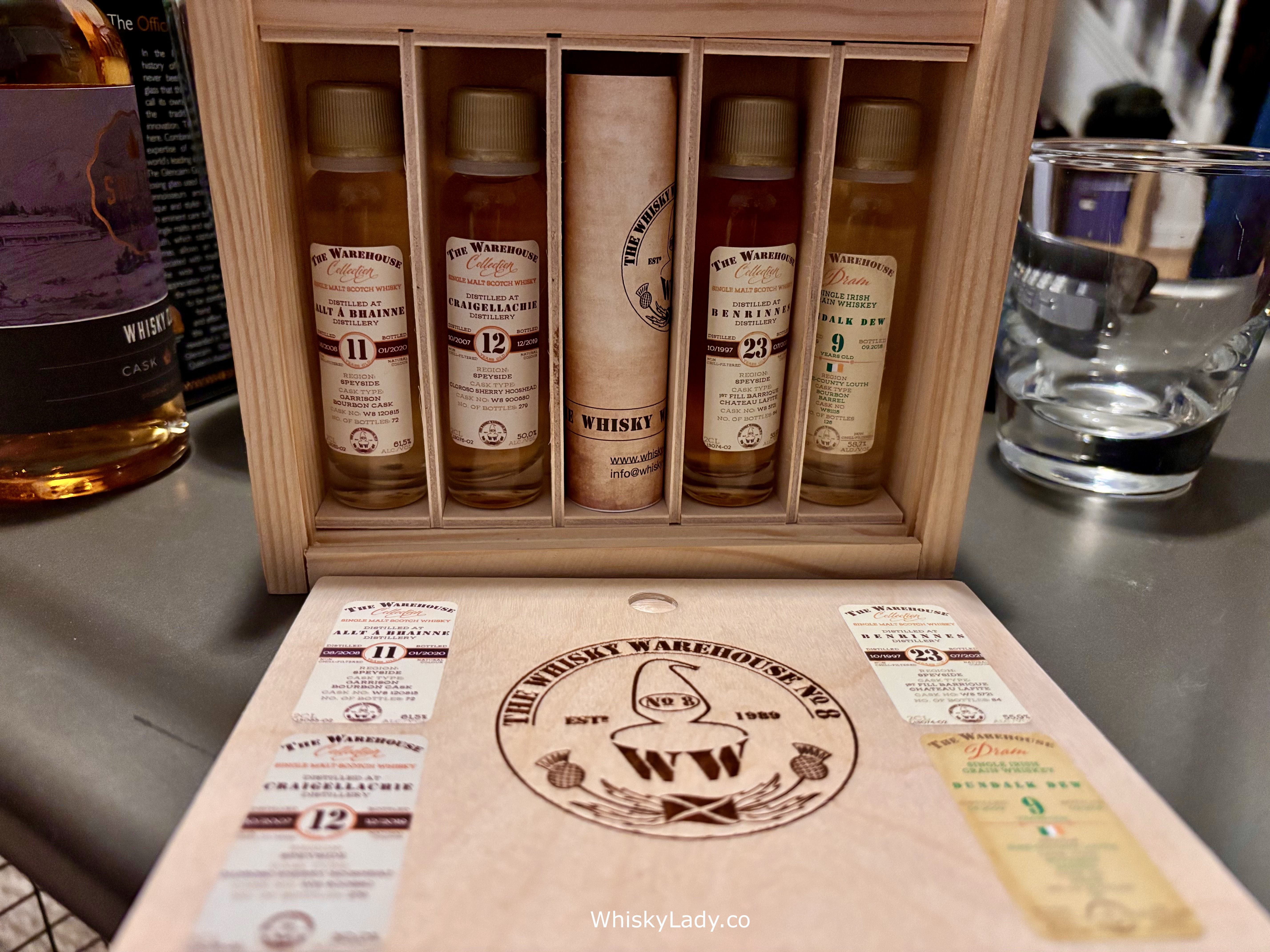
For a whisky explorer, small 20 ml bottles are a perfect way to try! Enter the Whisky Warehouse No 8 quartet – a mix of different drams that made its way from Nuremberg to Winnipeg… and then waited for more than a year for just the right evening in October 2024!

We decided to try the drams in the following order…. Some were “Yes please”, some were “Not for me”. Overall it was good fun to split between the three of us!

  • Ireland – Dundalk Dew 9 year (2009) Single Grain  58,7 %
  • Speyside –  Craigellachie 12 year (2007) 50 %
  • Speyside – Allt á Bhainne 11 year (2008) 61,5%
  • Speyside – Benrinnes 23 year (1997) 1st Fill Barrique Chateau Lafite 55.9%

We naturally started with the Irish grain, anticipating it would be a nice way to ease into our tasting set.

Dundalk Dew 9 year (June 2009 – Sep 2018) Single Grain, Bourbon Barrel Cask No W8118  58,7 %. 126 Bottles

  • Nose – Curious… it began a bit musty, then florals, some cereals, honey, opening further into cream and vanilla
  • Palate – Had a strength of character with no harshness, surprisingly balanced, uncomplicated yet imminently sippable, some bitter tart crisp apples
  • Finish – Not much but then not much was expected either

For a young grain, it was quite remarkable. There was a fresh summery quality – a nice warm weather dram where the appealing aromas follow through with a pleasant palate.

Rather a nice way to begin our evening!


We carried on with the Craigellachie – opting for a touch of sherry at a lower ABV over the Allt á Bhainne at 61.5%!

Craigellachie 12 year (Oct 2007 – Dec 2019) Olorosso Sherry Hogshead Cask No W8 900680 50,5%. 279 Bottles

  • Nose – Sour mash, apple sauce, toffee, over-ripe peaches, eases into red striped caramel hard candy
  • Palate – Bland… a bit blah actually with just generic fruit
  • Finish – Limited

Without water, it wasn’t much. The sour mash and over-ripe fruit aromas were almost overwhelming. However with water? It was a different dram entirely!

  • Nose – Is that toast and butter? Slathered in marmalade
  • Palate – Smooth honeyed sweetness
  • Finish – Lingers

As we contemplated our glasses, it was hard to think this was the same whisky! The more time in the glass, the warmer and more enjoyable it became.


Next up was another Speyside – this time from Allt á Bhainne – I believe the first I’ve tried from their distillery. Interestingly, it has a Canadian connect –  founded in 1975 by Seagrams, passing to Pernard Ricard, assigned to its Chivas Regal division, largely used in blends with a period of even mothballed for a couple of years before being re-activated in 2005.

Allt á Bhainne 11 year (Aug 2008 – Jan 2020) Garrison Bourbon Cask No W8 120815 61,5%. 72 bottles

  • Nose – Ah! Now we are talking! We were greeted by orchard fruits – crisp green apples and pears, then it shifted into chocolate and fruit – think a high-end orange peel and dark chocolate. Yum! The more it opened, the more enticing it became – strawberry and cream
  • Palate – Quite a bit of spice – not so surprising at 61.5%! Warm
  • Finish – Sweet spices of cloves and cinnamon
  • Water – Do try. Whilst it dampens the nose, it does wonders for the palate. Whilst it still has a prickle of spice, it is now more like Christmas pudding with a warm whisky sauce than hot spice!

This one really grew on us… I wasn’t sure what to expect but this dram had promise.


Last up we went to an older Benrinnes. Now I must admit, I’ve had some mixed experiences with this distillery.

Benrinnes 23 year (Oct 1997 – July 2021) 1st Fill Barrique Chateau Lafite Cask No W8 5721 55.9%. 84 Bottles.

  • Nose – Woah? Is that peat? Yup! A clean dry wood smoke – unmistakable and completely unexpected. Think apple wood chips smoldering. Also hay bales, roasted hazelnut.
  • Palate – Start well then changes, catching one at the back of the throat, unbalanced
  • Finish – More smoke
  • Water – Like the others – water is recommended. It makes it a bit more approachable

I was prepared for a great or disappointing experience. However, I was not prepared for peat. Which is a good reminder to keep an open mind and be ready to be surprised!

What about prior explorations from Whisky Warehouse No. 8? Over the last couple of years, we’ve sampled a few – with the Glencadam 8 being exceptional! Here is a short summary:

If you don’t want to miss a post, why not follow Whisky Lady on:

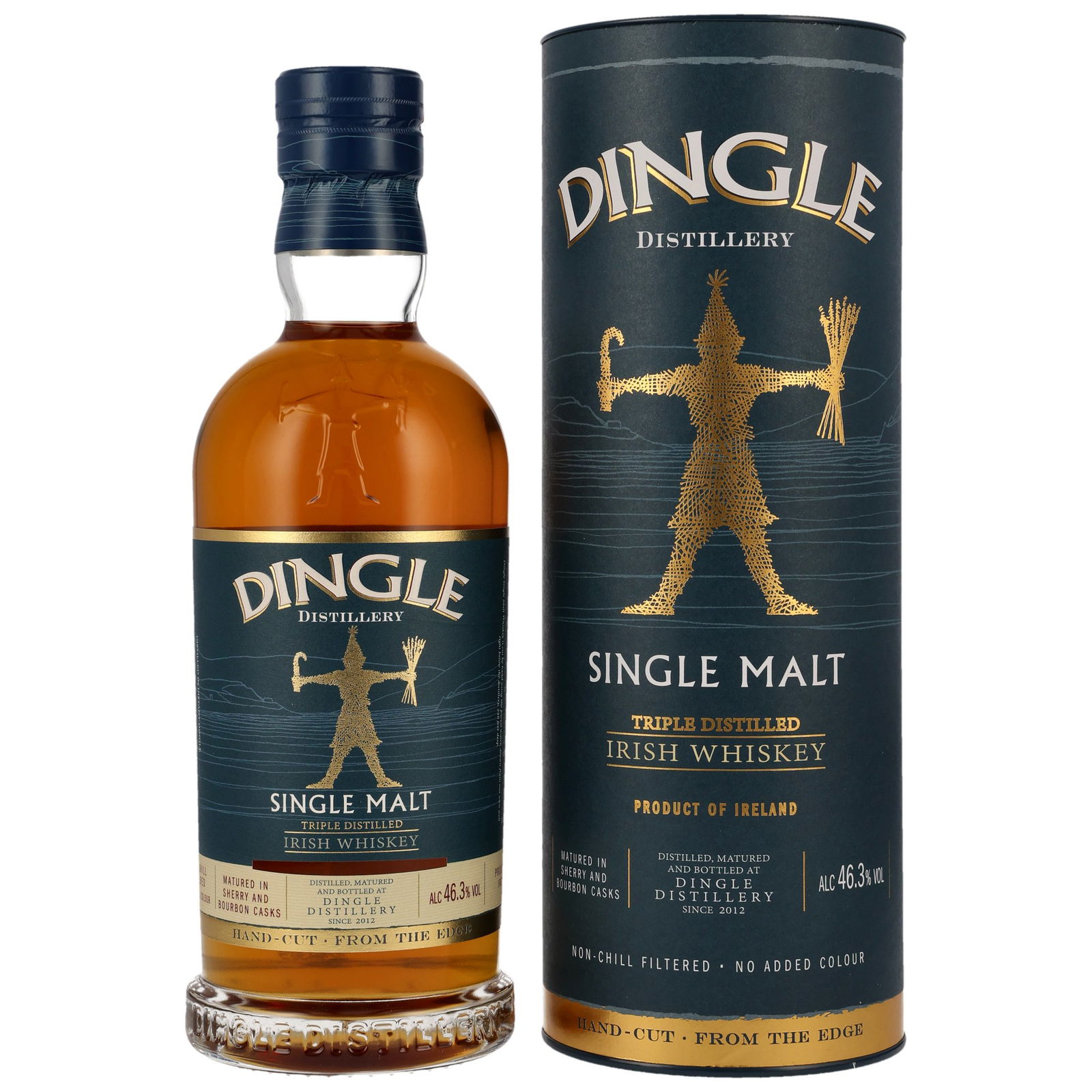
Ireland’s Dingle Single Malt 2021 46.3%

Sometimes when you order whiskies online in Germany, a little “extra” is thrown in. Such was the case with this wee Dingle mini.

Now it isn’t my first brush with Dingle, back in 2019 it featured in an evening of Irish whiskies – where we sampled Dingle Triple Distilled Batch 3 46.5%. As for this sample, I’m not sure which batch it is, however I understand it was matured in PX-Sherry and ex-Bourbon casks.

Dingle Single Malt (2021) 46.3%

  • Nose – Much like my earlier experience, I found it quite vegetal, an odd approach like compost and old leaves. It became sweeter, with cereals, minerals, and fresh seawater. A hint of cinnamon… over time it also revealed some herbs and perhaps even a touch of lime? Also a bit “dusty” for lack of a better way to describe
  • Taste – A prickly spice to start (it was the 1st dram after all!), after the harshness settled down a bit, revealed some raisins, mixed with bitter nuts
  • Finish – Peculiar… closest I could think of was rancid walnuts.. bitter and not very pleasant

It did not excite or delight. I set it aside to see if and how it changes with more time. Nope. Not for me.

What do the folks at Dingle have to say? Well… without knowing exactly which batch, can’t say for certain. As for what would it set you back? If you picked it up at Whic.de, you would be looking at Eur 45.

I must admit that though it was nice to get a sample, this would not have been my pick! However, that’s the whole point of a “bonus” – an opportunity to tease you into trying something you may not have selected off the shelf!

Want even more Whisky Lady posts? Follow this blog on:

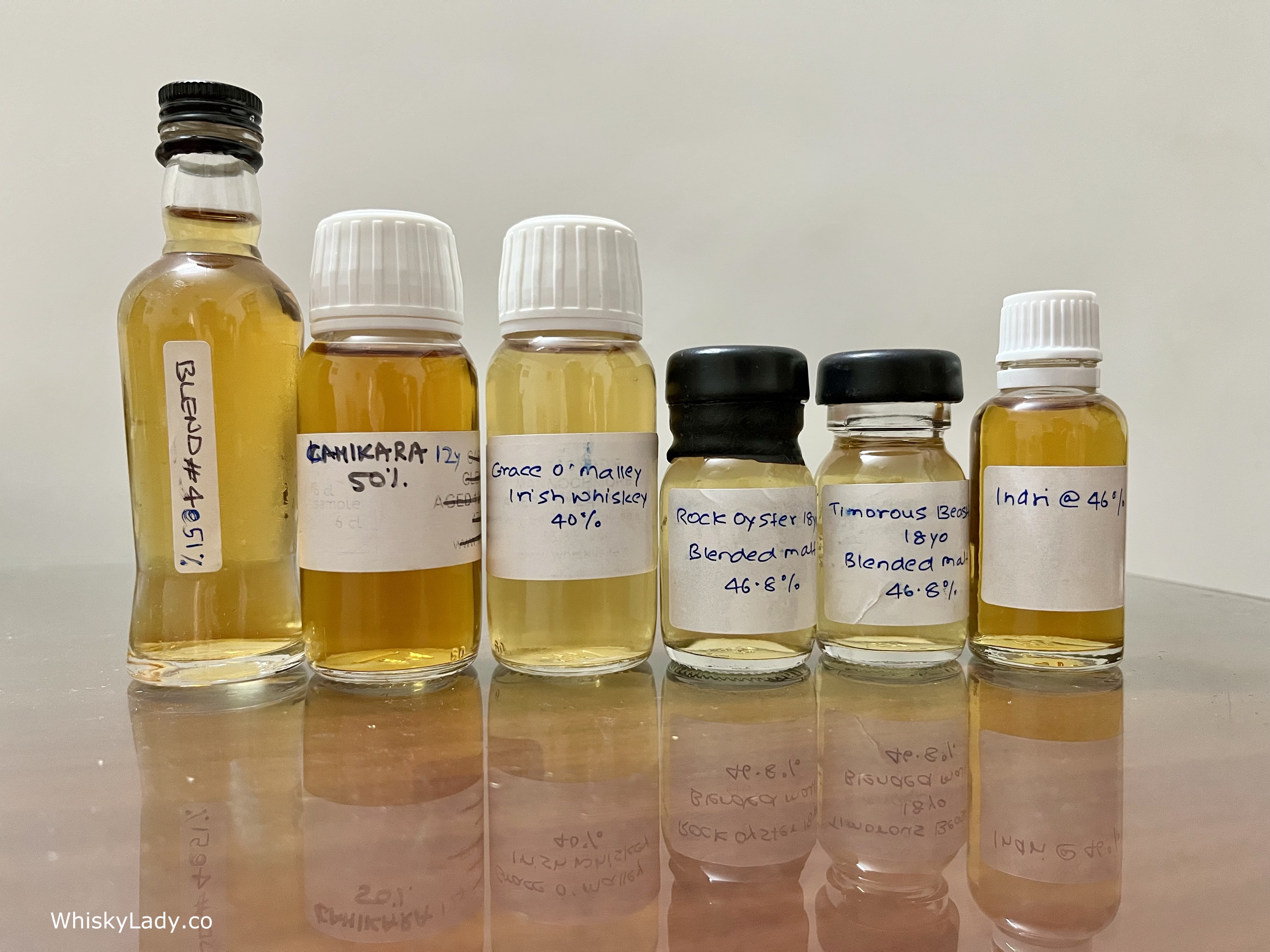
Grace O’Malley Blended Irish Whiskey 40%

April in Maharashtra can be hot and dry. Not exactly whisky-sipping weather. However as the sun set, our air mist helped drop the temperature further, and we thought what the heck! Let’s try a dram or two.

Conveniently, I received a “return gift” with an interesting assortment of samples from a fellow whisky explorer, sharing miniatures from his open bottles. This Irish whisky was in the mix and seemed just the right place to begin.

What did we think?

Grace O’Malley Irish Blended Whisky 40% 

  • Nose – Sunshine happiness in a glass, hint of rye, vanilla, some citrus
  • Palate – Sunny, salty, and easy to sip, just as friendly, a spring-like quality
  • Finish – Salty almonds or a light nougat

Like many Irish whiskies, this was an amiable dram. Perhaps it was just the setting, however, we enjoyed it. Nothing remarkable. Nothing really stood out. However, it was a perfect starting point for a warm evening in rural Maharashtra.

What about their official tasting notes?

  • Nose – Caramel, vanilla, maritime notes, orange peel & honey
  • Palate – Salt, well balanced with salty undertones
  • Finish – Middle Eastern pastry, sweet, saline & toasted notes

In Germany, one can buy this entry Grace O’Malley expression for ~21 Eur. Not such a bad price point at all.

What more do we know? And who was Grace O’Malley? She was an Irish pirate queen – a charismatic leader from the nobility of County Mayo – whose story was the inspiration for a trio of gents (One Irish, two German) to create this brand. It will be interesting to see what these folks put out with their own liquid.

If you don’t want to miss a post, why not follow Whisky Lady on:

Not your ordinary blend!

We were toying around with ideas for whisky themes for our wee Nurnberg International Whisky Explorers group, and proposed exploring inventive and interesting blends. The goal was to avoid all mass-produced well-known names. Instead, we challenged ourselves to research and bring something a bit different for each other to discover!

So what made its way into our theme of “Not Your Ordinary Blend“?

Technically the last isn’t a blend, however, we were delighted to have it close our evening – in honour of our birthday lass!

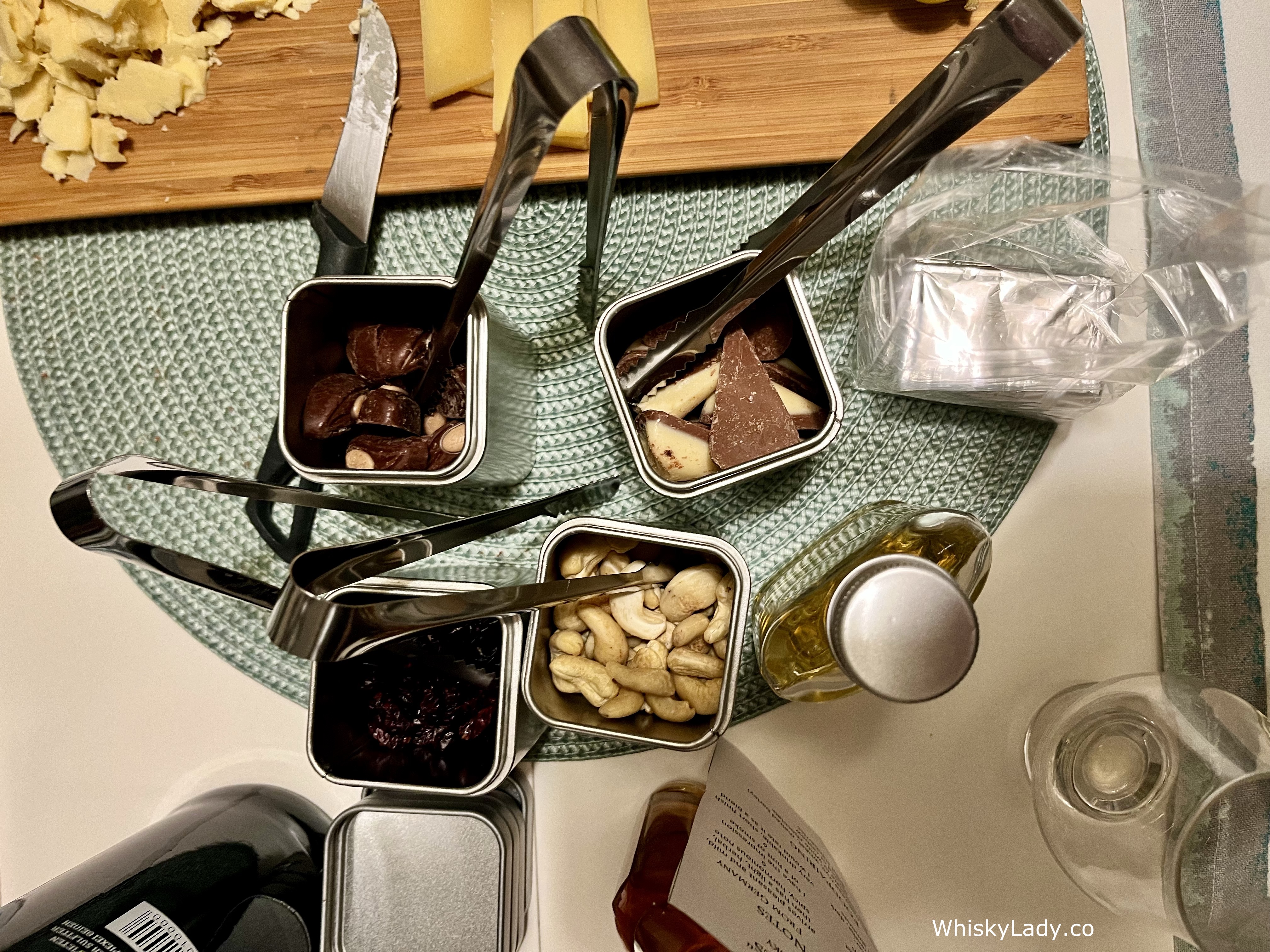
We then had a “bonus” round with Two of Pentacles blended whisky alongside a pairing – with nuts and chocolate with special wafers joining our usual close with cheese and bread to help soak up the alcohol before going our different ways. This addition was a complete hit! And certainly something to consider for future sessions.

Interested in joining our Nurnberg Whisky Explorer events? Just find us on Meetup! https://www.meetup.com/nurnberg-whisky-explorers/events/

And if you don’t want to miss a post, why not follow Whisky Lady on:

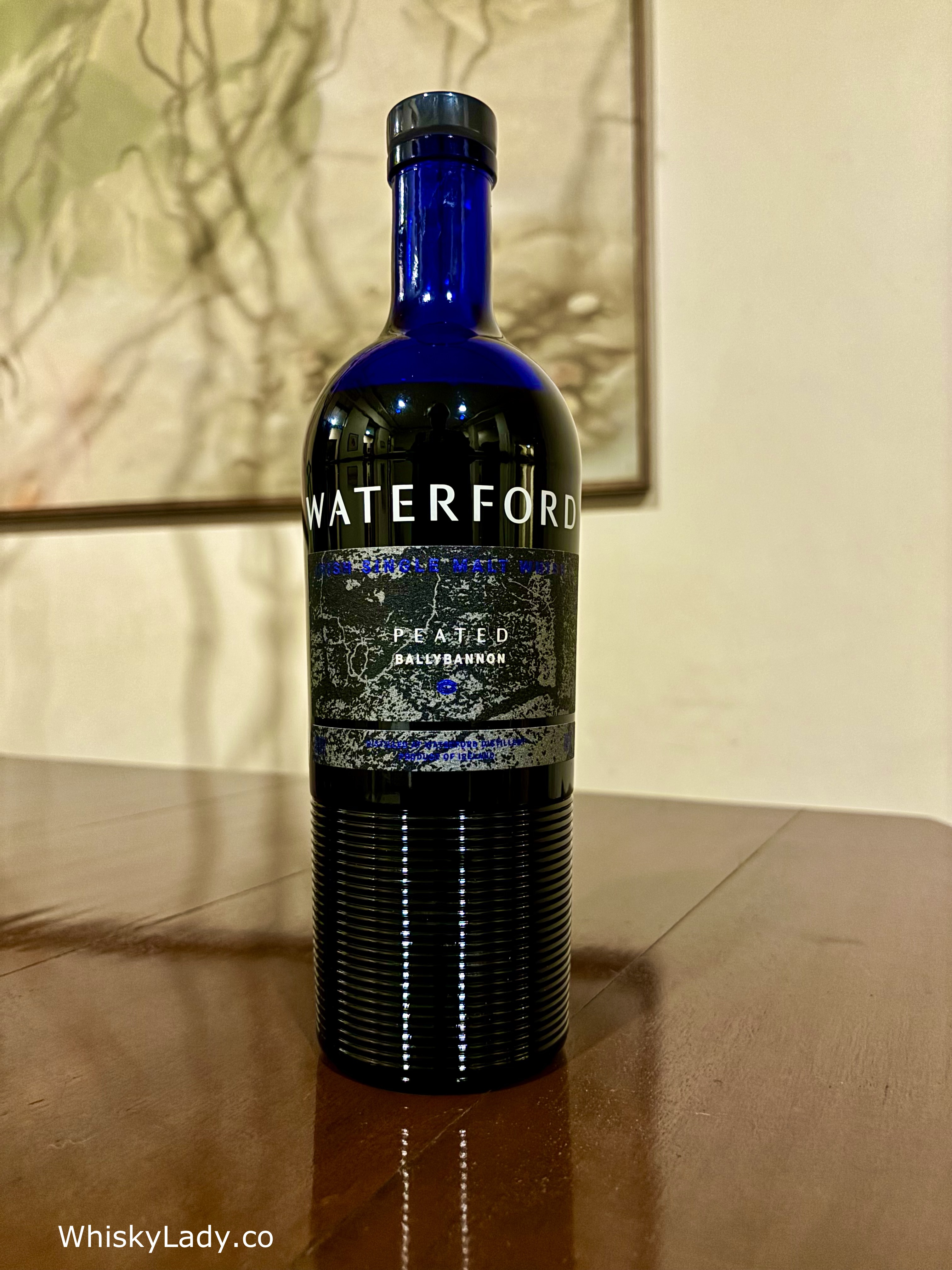
Waterford Irish Whisky – Arcadian Farm Origin Peat Ballybannon 1.1 50%

When Waterford Irish Whiskies introduced their peated expressions, there was surprise. This was not what was expected or even talked about. And in keeping with the Waterford philosophy of ensuring the whisky was fully Irish, this meant tracking down Irish peat.

Waterford Arcadian Farm Origin Peated Ballybannon 1.1 (17 Sep 2018 – Aug 2022) Terroir P062E01-01 50%. 11,088 bottles. Retailing worldwide for Eur 92.

  • Nose – Woah peat! Then it started to settle down. Burnt rubber. A curl of acrid smoke. Iodine then campfire. Wet mop or a wet wool sweater with a distinctly humid smell. Shifted into yoghurty baby puke.
  • Palate – High heat then sweet cured meats. It was more bitter on the palate than the nose indicated. Also some salty damp elements too. Dare I say it has a kind of maritime quality?
  • Finish – Peat and spice with cinnamon
  • Water – Doesn’t do much. Subdues the palate but despite softening a bit, doesn’t shift the character significantly
  • Revisit – Is this the same whisky? Clearly, it needs much more time in the glass. The peat remains very much there however a sweet honey joins the seaweed with the fire dampened, and the palate becomes smooth – much more approachable with a bit of apple sauce easing into a nice cinnamon finish.

Fascinating. The peat was certainly unlike a Scottish peat, having a maritime swagger. At 47 ppm, it isn’t overwhelming. And definitely needs time to open up.

If you are curious to know more – check out the video telling the tale of how the folks at Waterford approached acquiring and using peat in their whiskies.

As for our specific dram, If you have never heard of Ballybannon farm? Well then read on…

Ballybannon in Co. Carlow could be the perfect terroir for growing barley for peating. Sitting on raised ground along the banks of the River Barrow, its heavy, lime-rich soils — archetypal Elton series — are directly adjacent to sphagnum-dense inland bog. Small wonder then that the Pender family’s barley and peat from Niall Carroll’s Ballyteige cuttings in Co. Kildare have proven such a natural combination. Such is Ballybannon barley’s natural affinity for peat, that we have been able to kiln-dry it to a high 47ppm and still find that the character of Ballybannon’s terroir itself remains the dominant flavour in the spirit. Along with its sister bottling, Fenniscourt, Peated Ballybannon represents the first marriage of Irish barley and Irish peat in generations.

Curious about the maturation period? 1346 days or 3 years, 8 months, 7 days. Want to know about the barley? Laureate. Yeast? Mauri distiller’s yeast. Production water? Volcanic aquifer. Fermentation period? 167 hours. Description of the soil? Fine, loamy drift, Elton association soils. Barrel composition?

  • 38% American First Fill (presumably ex-bourbon)
  • 21% American virgin oak
  • 30% French premium casks
  • 11% Vin doux natural

And the Head Distiller’s observations?

  • APPEARANCE: Light gold with everlasting oils.
  • NOSE: Soft peat, almonds, crisp, lavender honey, reminds me of a seaside escape, driftwood fire smoke, green apples, padrón peppers, salt crust, a morning walk on a fresh day.
  • TASTE:  Peat kick, very chewable, BBQ fish by the sea, buttery, warm apple and almond tart with honeycomb ice cream, wool, frangipane, samphire.
  • FINISH: What finish?!

All in all – what an experience! It will be interesting to see how Waterford evolves. And a good reminder of why being part of a tasting group is so rewarding – one is introduced to whiskies that likely otherwise might not have tried. So thank you to our whisky host of the evening!

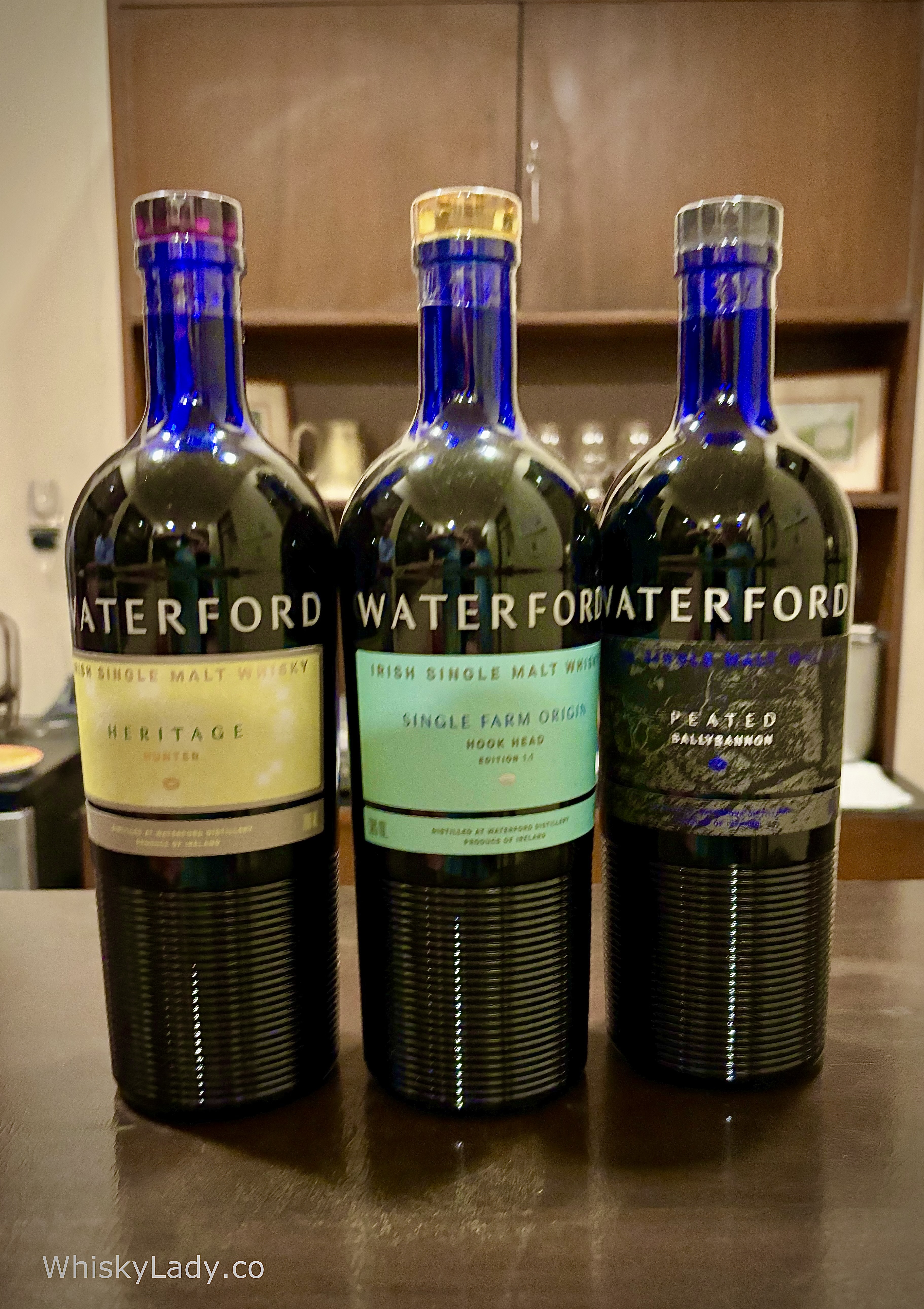
What did we try in our evening devoted to exploring Waterford Irish Whisky?

Curious about more Whisky Lady ramblings? Why not follow on:

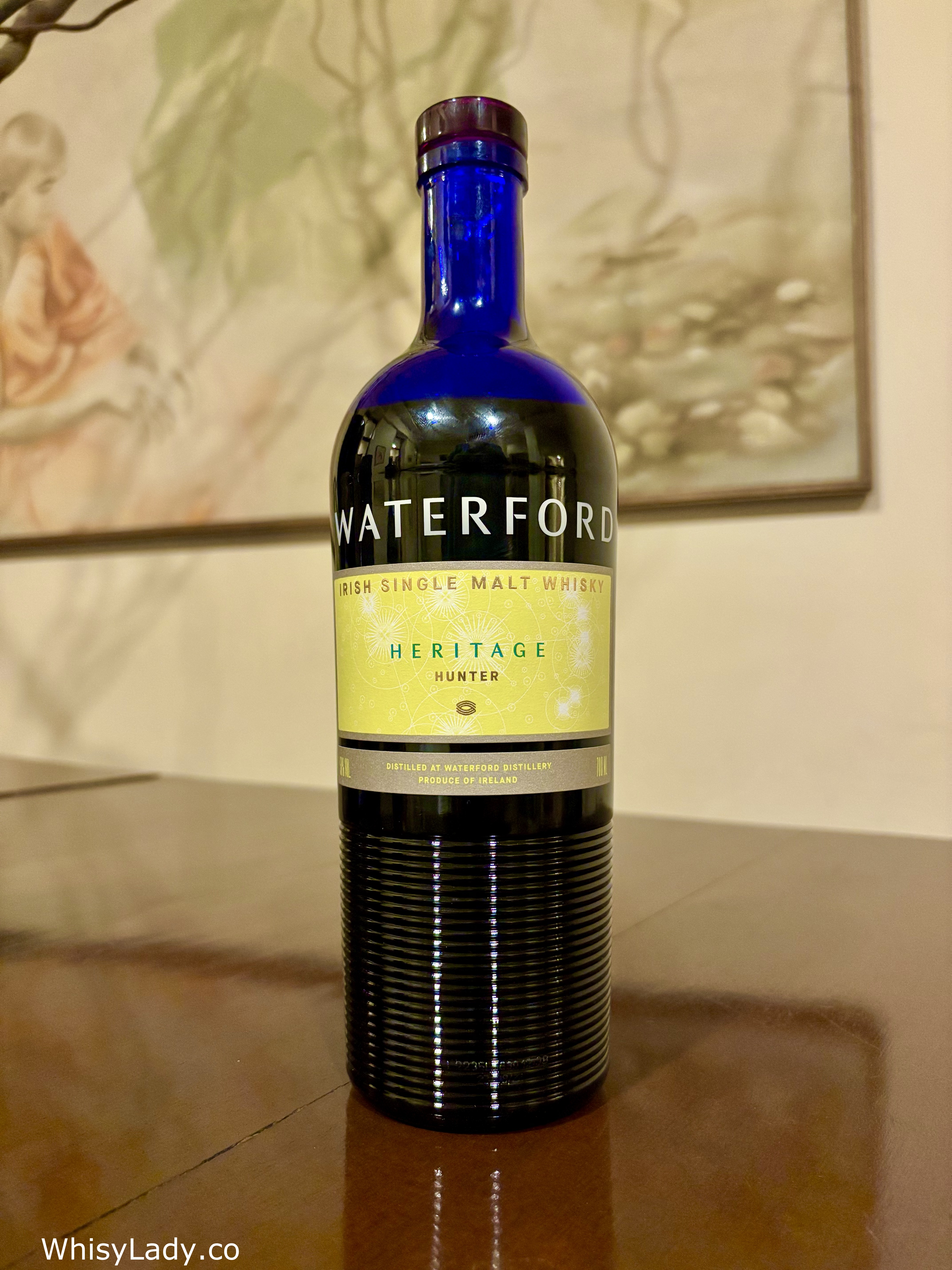
Waterford Irish Whisky – Arcadian Farm Origin Heritage Hunter 1.1 50%

Welcome to the world of Waterford Irish Whiskies… where things are clearly being done a bit differently.

After sampling the very salty Single Farm Origin “Hook Head” 1.1, we moved on to their Arcadian Farm concept – more precisely the Heritage Hunter expression:

Hunter, named after pioneering plant breeder Dr Herbert Hunter, was introduced in 1959 and  was for almost two decades noted for its distinctive flavour. We now reintroduce this game-changing barley to a new era of single malt connoisseurs. Vanished from the Irish landscape since the late 1970s, superceded by more economically rewarding crosses, all that remained of Hunter was a 50 gram bag in the seed bank of the Irish Department of Agriculture, Food & the Marine.

Planted in greenhouse grow bags, this 50 grams grew to four kilograms, and the cycle went again and again over two years, until there was enough for  ten acres at our partner Minch Malt’s test site in Athy. Test successful, Hunter was sown on a commercial scale on the lime-rich Elton series terroir of Donoughmore, yielding 25.5 tonnes of malting barley — enough to fill 50 casks. It is from that first pioneering distillation that this whisky has been drawn.

Now on to the whisky…

Waterford Arcadian Farm Origin Heritage Hunter 1.1 (23 Feb 2019 – Aug 2022) Terroir HE01E01-01 50% 9048 bottles. Worldwide distribution, sold out at Eur 100

  • Nose – Well well well… what have we here? For some, it began as caramel sweetness. For others, it was like walking into a chemistry lab! There was an organic agricultural quality. Then it shifted to different woods – particularly dry wood shavings, there was even a savoury side, which then was replaced with sweet
  • Palate – Deceptive as it began with sweet then the spice kicks in! Young, quite active. Think of an old peach pit. Another found dried prune seeds liquor. There is a vegetable earthy quality too. Yet sweet too… with a hint of dried orange
  • Finish – Lasts with a bit of burn, more peach pit with some bitter clove oil? Then salt
  • Water – A few drops opens it up a bit
  • Revisit – It sounds curious, yet for me it was spicier

If the Single Farm Origin “Hook Head” reminded me of the Bruichladdich Micro-Provenance experiments, the Arcadian Farm “Heritage Hunter” reminded me of some of AD Laws forays into ancient grains and barleys. Except MUCH better!

I described it as chewing raw grains or barley. I received a few quizzical looks. For some, this seemed to be the preferred.

Now diving deep into the details, we start with the terroir:

A dry and windy summer’s day at Donoughmore. This track begins inside some of the old stone sheds at the edge of the fields. Time has rendered them open to the elements, but they still give a little shelter. Heading outside into the open, the wind rattles the loose sheeting on a nearby barn, we’re surrounded here by a semicircle of trees filled with busy birds in the afternoon sun. A gap in the trees leads us out into the fields, the wind buffeting the barley as it blows through heading south.

Want to know about the maturation period? 1161 days or 3 years, 2 months, 6 days. Want to know about the barley? Hunter (obviously!). Yeast? Mauri distiller’s yeast. Production water? Volcanic aquifer. Fermentation period? 169 hours. Description of the soil? Fine, loamy drift with limestones, Elton association. Barrel composition?

  • 45% American First Fill (presumably ex-bourbon)
  • 18% American virgin oak
  • 21% French premium casks
  • 16% Vin doux natural

How does all of this equate into the glass? Here are the Head Distiller’s observations

  • APPEARANCE: Pale gold with unctuous oils.
  • NOSE: Earthy, dry soil, lemon sherbet, red apple skin, dry bark, barnyard, petrichor, rolled barley, baked salt, chalk.
  • TASTE: Orange cake, dry savoury spice, cloves, porridge with prunes, wood char, citrus oils.
  • FINISH: Dry greenness with a gentle spice.

And there you have it!

What did we try in our evening devoted to exploring Waterford Irish Whisky?

Curious about more Whisky Lady ramblings? Why not follow on:

Waterford Irish Whisky – Single Farm Origin Hook Head 1.1 50%

Before we started, our whisky host shared that we could expect a salty whisky, a spicy whisky, and a smoky whisky. So we decided to begin our journey into Waterford Irish Whiskies with the one reputed to be the most maritime of the lot! The “Hook Head” is described as:

The lighthouse at Hook Head stands resolute against the full force of the Atlantic Ocean on Ireland’s southern coast, 10 miles from the distillery – so close that Oliver Cromwell vowed to take Waterford ‘by hook or by crook’ in the 17th century. In its shadow, Martin Foley grows barley on clay/loam soils derived from limestone, belonging to the Elton series. Exposed to the full range of salt-laden storms, sea mists & ocean breezes, it’s an extreme maritime terroir.

As you will see – we would indeed agree if salty is an expression of extreme maritime terroir, it is indeed apt!

Waterford Single Farm Origin Hook Head 1.1 (19 Jan 2017 – 14 Feb 2021) Terroir F035E01-01 50% 12,000 bottles for Germany. Retailing for Eur 80

  • Colour – Light straw
  • Nose – An almost agricultural whiff at first, malted barley, sweetening the more time it spends in the glass. Shifted between Ovaltine and Marmite. Then we were hit with salty sea spray and how! Joined by something at first dusty then distinctly mineral, wet granite. Followed by a hint of salty honey-coated nuts that then back to saline
  • Palate – Mineral, oily then sweet, a warming heat more than spice per se, though perhaps there was some white pepper in there. More vegetal than fruit. There was also a return of a milky Ovaltine. The 2nd sip was pure salt – like sucking on a salt rock!
  • Finish – Lasts yet is super salty and drying in the mouth
  • Water – With a few drops the sweetness comes more to the fore on the nose revealing a lightly floral element and pushing the saltiness back a bit. It also becomes softer on the palate, more mineral than salty alone. With a more generous splash, this becomes one fine dram, creamy, interesting, and much more up my alley!
  • Revisit – After sampling all three Waterfords, I returned to the glass to discover citrus koolaid and vanilla, with the saline fully under control!

Overall this was quite an interesting start to our explorations of Waterford. There was no doubt distinctive things were going on. This was no bog-standard social Irish dram. This was an experiment in a glass. And reminded me of the Bruichladdich micro-provenance experiments – just without peat!

This was my favourite… and the one I returned to for the balance of the evening whilst the gents pupped away at their rare cigars.

What more do we know? A whole heck of a lot in this case! It is more a question of where to begin??

Let’s start with Terroir – using the bottle label – we learn that everything comes from Tinnashrule farm in Wexford:

John Crowley farms at Tinnashrule – The Hollytree Crossroads – in the rain shadow of the Blackstairs Mountains, north of Enniscorthy. Here the rolling lowland barley fields lie in the lee of ash & larch woods, benefiting from well-drained loam & clay loam of the famously productive Clonroche series, on glacial drift derived from Ordovician shale & granite.

Want to know about the maturation period? 3 years, 8 months, 14 days. Want to know about the barley? Sebastian. Yeast? Mauri distiller’s yeast. Production water? Volcanic aquifer. Fermentation period? 152 hours. Description of the soil? Fine, loamy drift with siliceous stones and Clonroche series. Barrel composition?

  • 46% American First Fill (presumably ex-bourbon)
  • 22% American virgin oak
  • 15% French premium casks
  • 17% Vin doux naturel

We also have the Head Distiller’s observations on how these elements translate into aromas and flavours in the glass…

  • APPEARANCE: Light gold with oils.
  • NOSE: Sweet honeycomb, plums, rolled barley, mint, dark chocolate, orange zest, leather, rose water, aniseed, pear drops and has a warmth on the nose.
  • TASTE: Cloves, white pepper, dark creamy chocolate, fresh bread, grapefruit, dry but chewy, late spice explosion with a wasabi hit, orange syrup, root vegetables.
  • FINISH: Long, dry spiciness, which is also chewy.

Interestingly there are both descriptions for the exact “terroir” (as noted above) and the “Hook Head” expression. Confused? Shall we compare? The expression is described as:

  • Taste: spice bomb, cloves, white pepper, salted caramel, licorice, ginger biscuits, lemon zest, chili chocolate
  • Nose: earthy maltiness, fresh soil, citrus peel, bread crust, clove, white pepper, caramel, milk chocolate, salted popcorn, barnyard, oak green foliage
  • Finish: dry

Whilst not totally contradictory, there are certainly differences and nuances to each. As for us? Well, that was quite the intro! And now it is clearly time to move on to the 2nd and 3rd Waterford whiskies…

What did we try in our evening devoted to exploring Waterford Irish Whisky?

Curious about more Whisky Lady ramblings? Why not follow on:

Waterford Irish Whisky – Single Farm, Arcadian Heritage, Peat

When you hear the word “Waterford” one typically thinks of crystal glasses, not whisky! This is readily understandable given one has a tradition that harkens back to 1783 and the other was founded only in 2016 – not even a decade old!

However, there we were in South Bombay, a fine evening at the end of March 2024, about to embark on a journey into one of the newest and most original players in the Irish whisky revival scene.

In this case, it is notable the choice of spelling “whisky” without an “e” and the claim that the distillery is “40 years in the making“, given the role Mark Reynier has played in founding a distillery devoted to terroir, biodynamic, and cuvées.

Even the boxes tell a story – signaling the type of whisky category to be explored. Would it be a Single Farm with clean firm lines? Or Arcadian Farm with a few lines joining to bring their different elements into a single experience? And where peat is in the mix, the box colour shifts to a smokey grey with black. There is a 3rd concept devoted to Cuvées which we did not experience.

Here is what the folks at Waterford have to say about their Single Farm Origin line “precision of place”:

Each Single Farm Origin is a compelling and intriguing whisky, but also an intellectual challenge to the whisky world’s status quo. Our radical, uncompromising philosophy allows inquisitive drinkers to join our exploration of the frontiers of authentic flavours, to search beyond conventions and to celebrate individuality.

One place, one farm, at a time.

And now what they share about their Arcadian Farm Origin line with a few options “the old ways – organic, biodynamic, peated & heritage”:

We ask what organic farming, or the ancient wisdom of biodynamics can offer to the intensity of barley’s flavour. Our curiosity leads us to discover then resurrect rare heritage grains, one variety at a time; and to experience the pungency of real Irish peat for the first time in generations in whisky. With these radical methods we ask the inquisitive, daring drinker to join us on our unorthodox journey towards the frontiers of authentic, uninhibited flavour.

What did we try?

The more I looked into the approach here, the more I recognized this is true whisky “geek” territory! Curious what the farm where the barley was grown sounds like? The exact location of where the barley was grown, who did what, and how? The organisms that live in the soil? Old wives’ tales converted into accumulated knowledge, combined with the cycles of the moons around the earth into science. The impact of how agro-business has “buggered the soil”, the importance of barley seeds from before 1967, and the role of air and composting? Enquiring minds will get answers to questions they didn’t even know to ask!

Curious about more Whisky Lady ramblings? Why not follow on: