Waterford Irish Whisky – Arcadian Farm Origin Peat Ballybannon 1.1 50%

When Waterford Irish Whiskies introduced their peated expressions, there was surprise. This was not what was expected or even talked about. And in keeping with the Waterford philosophy of ensuring the whisky was fully Irish, this meant tracking down Irish peat.
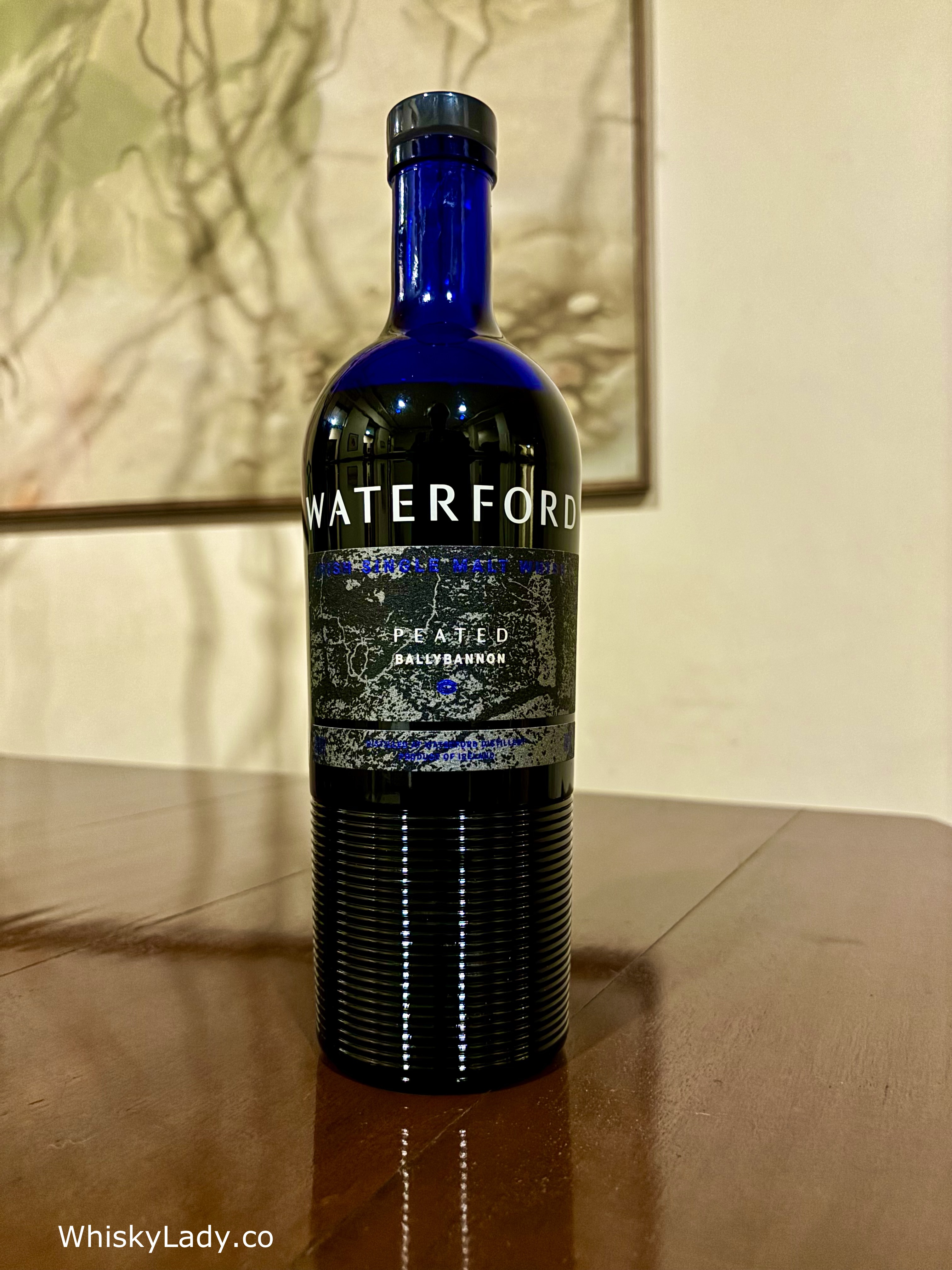
Waterford Arcadian Farm Origin Peated Ballybannon 1.1 (17 Sep 2018 – Aug 2022) Terroir P062E01-01 50%. 11,088 bottles. Retailing worldwide for Eur 92.

  • Nose – Woah peat! Then it started to settle down. Burnt rubber. A curl of acrid smoke. Iodine then campfire. Wet mop or a wet wool sweater with a distinctly humid smell. Shifted into yoghurty baby puke.
  • Palate – High heat then sweet cured meats. It was more bitter on the palate than the nose indicated. Also some salty damp elements too. Dare I say it has a kind of maritime quality?
  • Finish – Peat and spice with cinnamon
  • Water – Doesn’t do much. Subdues the palate but despite softening a bit, doesn’t shift the character significantly
  • Revisit – Is this the same whisky? Clearly, it needs much more time in the glass. The peat remains very much there however a sweet honey joins the seaweed with the fire dampened, and the palate becomes smooth – much more approachable with a bit of apple sauce easing into a nice cinnamon finish.

Fascinating. The peat was certainly unlike a Scottish peat, having a maritime swagger. At 47 ppm, it isn’t overwhelming. And definitely needs time to open up.

If you are curious to know more – check out the video telling the tale of how the folks at Waterford approached acquiring and using peat in their whiskies.

As for our specific dram, If you have never heard of Ballybannon farm? Well then read on…

Ballybannon in Co. Carlow could be the perfect terroir for growing barley for peating. Sitting on raised ground along the banks of the River Barrow, its heavy, lime-rich soils — archetypal Elton series — are directly adjacent to sphagnum-dense inland bog. Small wonder then that the Pender family’s barley and peat from Niall Carroll’s Ballyteige cuttings in Co. Kildare have proven such a natural combination. Such is Ballybannon barley’s natural affinity for peat, that we have been able to kiln-dry it to a high 47ppm and still find that the character of Ballybannon’s terroir itself remains the dominant flavour in the spirit. Along with its sister bottling, Fenniscourt, Peated Ballybannon represents the first marriage of Irish barley and Irish peat in generations.

Curious about the maturation period? 1346 days or 3 years, 8 months, 7 days. Want to know about the barley? Laureate. Yeast? Mauri distiller’s yeast. Production water? Volcanic aquifer. Fermentation period? 167 hours. Description of the soil? Fine, loamy drift, Elton association soils. Barrel composition?

  • 38% American First Fill (presumably ex-bourbon)
  • 21% American virgin oak
  • 30% French premium casks
  • 11% Vin doux natural

And the Head Distiller’s observations?

  • APPEARANCE: Light gold with everlasting oils.
  • NOSE: Soft peat, almonds, crisp, lavender honey, reminds me of a seaside escape, driftwood fire smoke, green apples, padrón peppers, salt crust, a morning walk on a fresh day.
  • TASTE:  Peat kick, very chewable, BBQ fish by the sea, buttery, warm apple and almond tart with honeycomb ice cream, wool, frangipane, samphire.
  • FINISH: What finish?!

All in all – what an experience! It will be interesting to see how Waterford evolves. And a good reminder of why being part of a tasting group is so rewarding – one is introduced to whiskies that likely otherwise might not have tried. So thank you to our whisky host of the evening!
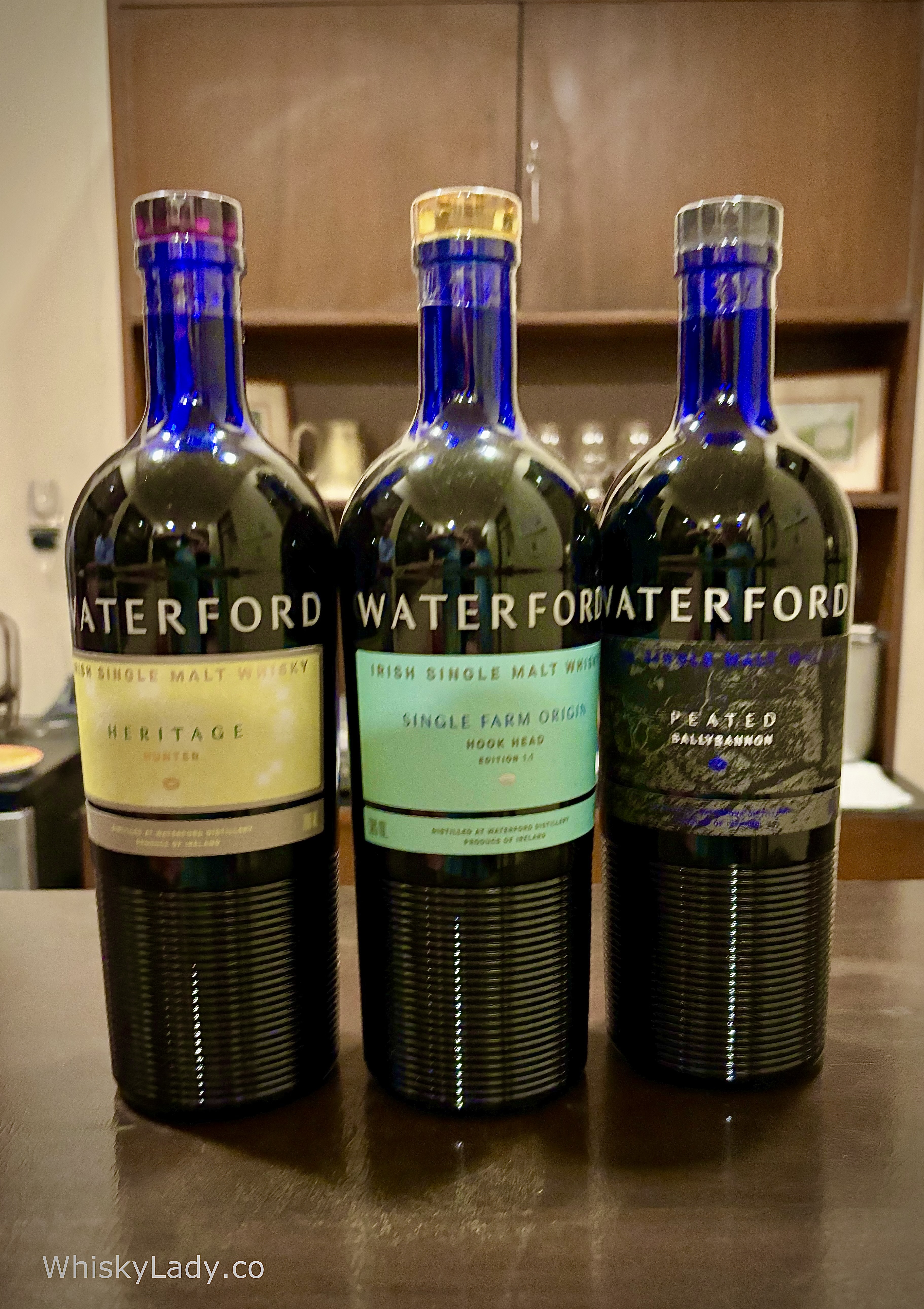
What did we try in our evening devoted to exploring Waterford Irish Whisky?

Curious about more Whisky Lady ramblings? Why not follow on:

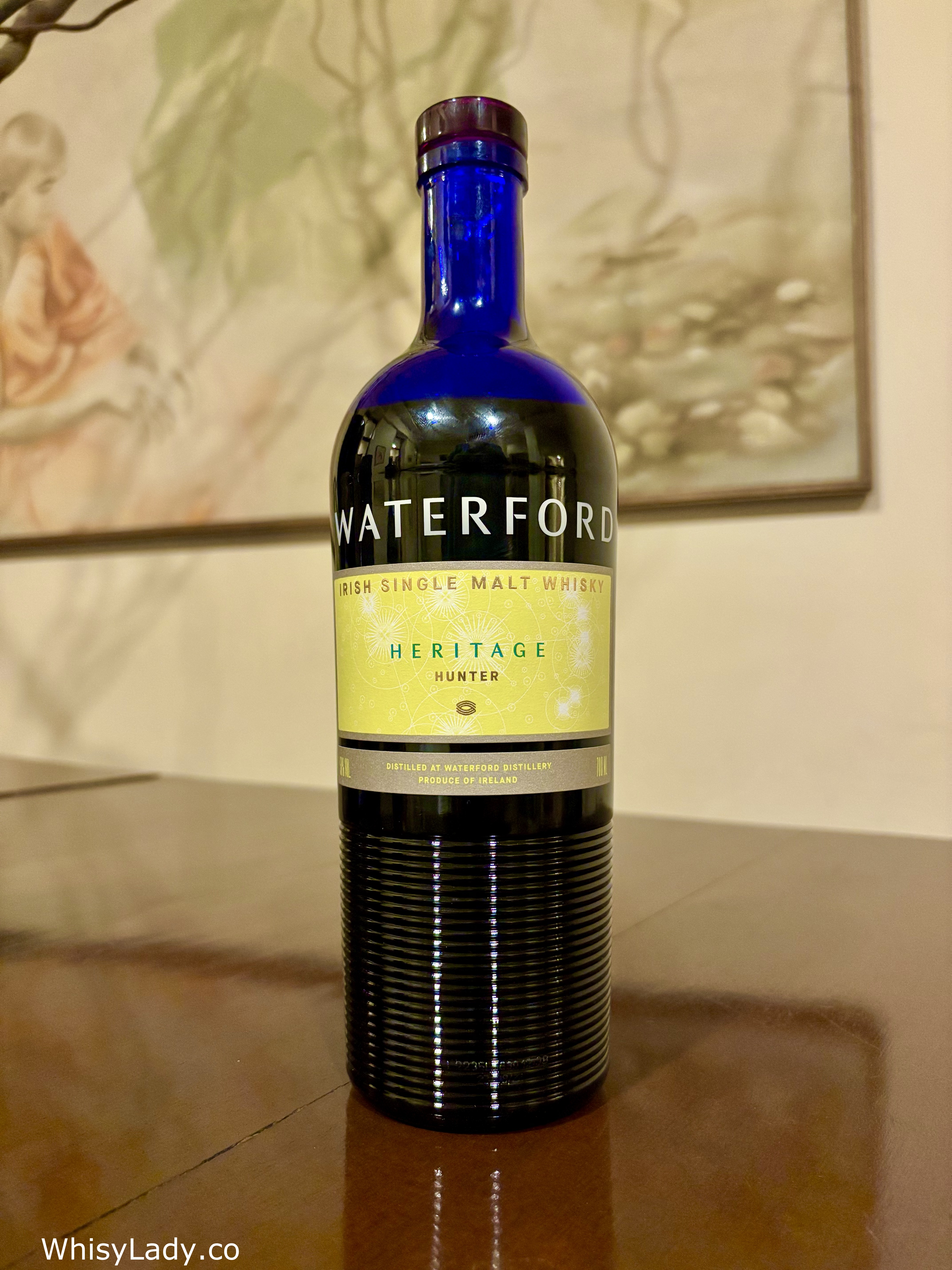
Waterford Irish Whisky – Arcadian Farm Origin Heritage Hunter 1.1 50%

Welcome to the world of Waterford Irish Whiskies… where things are clearly being done a bit differently.

After sampling the very salty Single Farm Origin “Hook Head” 1.1, we moved on to their Arcadian Farm concept – more precisely the Heritage Hunter expression:

Hunter, named after pioneering plant breeder Dr Herbert Hunter, was introduced in 1959 and  was for almost two decades noted for its distinctive flavour. We now reintroduce this game-changing barley to a new era of single malt connoisseurs. Vanished from the Irish landscape since the late 1970s, superceded by more economically rewarding crosses, all that remained of Hunter was a 50 gram bag in the seed bank of the Irish Department of Agriculture, Food & the Marine.

Planted in greenhouse grow bags, this 50 grams grew to four kilograms, and the cycle went again and again over two years, until there was enough for  ten acres at our partner Minch Malt’s test site in Athy. Test successful, Hunter was sown on a commercial scale on the lime-rich Elton series terroir of Donoughmore, yielding 25.5 tonnes of malting barley — enough to fill 50 casks. It is from that first pioneering distillation that this whisky has been drawn.

Now on to the whisky…

Waterford Arcadian Farm Origin Heritage Hunter 1.1 (23 Feb 2019 – Aug 2022) Terroir HE01E01-01 50% 9048 bottles. Worldwide distribution, sold out at Eur 100

  • Nose – Well well well… what have we here? For some, it began as caramel sweetness. For others, it was like walking into a chemistry lab! There was an organic agricultural quality. Then it shifted to different woods – particularly dry wood shavings, there was even a savoury side, which then was replaced with sweet
  • Palate – Deceptive as it began with sweet then the spice kicks in! Young, quite active. Think of an old peach pit. Another found dried prune seeds liquor. There is a vegetable earthy quality too. Yet sweet too… with a hint of dried orange
  • Finish – Lasts with a bit of burn, more peach pit with some bitter clove oil? Then salt
  • Water – A few drops opens it up a bit
  • Revisit – It sounds curious, yet for me it was spicier

If the Single Farm Origin “Hook Head” reminded me of the Bruichladdich Micro-Provenance experiments, the Arcadian Farm “Heritage Hunter” reminded me of some of AD Laws forays into ancient grains and barleys. Except MUCH better!

I described it as chewing raw grains or barley. I received a few quizzical looks. For some, this seemed to be the preferred.

Now diving deep into the details, we start with the terroir:

A dry and windy summer’s day at Donoughmore. This track begins inside some of the old stone sheds at the edge of the fields. Time has rendered them open to the elements, but they still give a little shelter. Heading outside into the open, the wind rattles the loose sheeting on a nearby barn, we’re surrounded here by a semicircle of trees filled with busy birds in the afternoon sun. A gap in the trees leads us out into the fields, the wind buffeting the barley as it blows through heading south.

Want to know about the maturation period? 1161 days or 3 years, 2 months, 6 days. Want to know about the barley? Hunter (obviously!). Yeast? Mauri distiller’s yeast. Production water? Volcanic aquifer. Fermentation period? 169 hours. Description of the soil? Fine, loamy drift with limestones, Elton association. Barrel composition?

  • 45% American First Fill (presumably ex-bourbon)
  • 18% American virgin oak
  • 21% French premium casks
  • 16% Vin doux natural

How does all of this equate into the glass? Here are the Head Distiller’s observations

  • APPEARANCE: Pale gold with unctuous oils.
  • NOSE: Earthy, dry soil, lemon sherbet, red apple skin, dry bark, barnyard, petrichor, rolled barley, baked salt, chalk.
  • TASTE: Orange cake, dry savoury spice, cloves, porridge with prunes, wood char, citrus oils.
  • FINISH: Dry greenness with a gentle spice.

And there you have it!

What did we try in our evening devoted to exploring Waterford Irish Whisky?

Curious about more Whisky Lady ramblings? Why not follow on:

Waterford Irish Whisky – Single Farm Origin Hook Head 1.1 50%

Before we started, our whisky host shared that we could expect a salty whisky, a spicy whisky, and a smoky whisky. So we decided to begin our journey into Waterford Irish Whiskies with the one reputed to be the most maritime of the lot! The “Hook Head” is described as:

The lighthouse at Hook Head stands resolute against the full force of the Atlantic Ocean on Ireland’s southern coast, 10 miles from the distillery – so close that Oliver Cromwell vowed to take Waterford ‘by hook or by crook’ in the 17th century. In its shadow, Martin Foley grows barley on clay/loam soils derived from limestone, belonging to the Elton series. Exposed to the full range of salt-laden storms, sea mists & ocean breezes, it’s an extreme maritime terroir.

As you will see – we would indeed agree if salty is an expression of extreme maritime terroir, it is indeed apt!

Waterford Single Farm Origin Hook Head 1.1 (19 Jan 2017 – 14 Feb 2021) Terroir F035E01-01 50% 12,000 bottles for Germany. Retailing for Eur 80

  • Colour – Light straw
  • Nose – An almost agricultural whiff at first, malted barley, sweetening the more time it spends in the glass. Shifted between Ovaltine and Marmite. Then we were hit with salty sea spray and how! Joined by something at first dusty then distinctly mineral, wet granite. Followed by a hint of salty honey-coated nuts that then back to saline
  • Palate – Mineral, oily then sweet, a warming heat more than spice per se, though perhaps there was some white pepper in there. More vegetal than fruit. There was also a return of a milky Ovaltine. The 2nd sip was pure salt – like sucking on a salt rock!
  • Finish – Lasts yet is super salty and drying in the mouth
  • Water – With a few drops the sweetness comes more to the fore on the nose revealing a lightly floral element and pushing the saltiness back a bit. It also becomes softer on the palate, more mineral than salty alone. With a more generous splash, this becomes one fine dram, creamy, interesting, and much more up my alley!
  • Revisit – After sampling all three Waterfords, I returned to the glass to discover citrus koolaid and vanilla, with the saline fully under control!

Overall this was quite an interesting start to our explorations of Waterford. There was no doubt distinctive things were going on. This was no bog-standard social Irish dram. This was an experiment in a glass. And reminded me of the Bruichladdich micro-provenance experiments – just without peat!

This was my favourite… and the one I returned to for the balance of the evening whilst the gents pupped away at their rare cigars.

What more do we know? A whole heck of a lot in this case! It is more a question of where to begin??

Let’s start with Terroir – using the bottle label – we learn that everything comes from Tinnashrule farm in Wexford:

John Crowley farms at Tinnashrule – The Hollytree Crossroads – in the rain shadow of the Blackstairs Mountains, north of Enniscorthy. Here the rolling lowland barley fields lie in the lee of ash & larch woods, benefiting from well-drained loam & clay loam of the famously productive Clonroche series, on glacial drift derived from Ordovician shale & granite.

Want to know about the maturation period? 3 years, 8 months, 14 days. Want to know about the barley? Sebastian. Yeast? Mauri distiller’s yeast. Production water? Volcanic aquifer. Fermentation period? 152 hours. Description of the soil? Fine, loamy drift with siliceous stones and Clonroche series. Barrel composition?

  • 46% American First Fill (presumably ex-bourbon)
  • 22% American virgin oak
  • 15% French premium casks
  • 17% Vin doux naturel

We also have the Head Distiller’s observations on how these elements translate into aromas and flavours in the glass…

  • APPEARANCE: Light gold with oils.
  • NOSE: Sweet honeycomb, plums, rolled barley, mint, dark chocolate, orange zest, leather, rose water, aniseed, pear drops and has a warmth on the nose.
  • TASTE: Cloves, white pepper, dark creamy chocolate, fresh bread, grapefruit, dry but chewy, late spice explosion with a wasabi hit, orange syrup, root vegetables.
  • FINISH: Long, dry spiciness, which is also chewy.

Interestingly there are both descriptions for the exact “terroir” (as noted above) and the “Hook Head” expression. Confused? Shall we compare? The expression is described as:

  • Taste: spice bomb, cloves, white pepper, salted caramel, licorice, ginger biscuits, lemon zest, chili chocolate
  • Nose: earthy maltiness, fresh soil, citrus peel, bread crust, clove, white pepper, caramel, milk chocolate, salted popcorn, barnyard, oak green foliage
  • Finish: dry

Whilst not totally contradictory, there are certainly differences and nuances to each. As for us? Well, that was quite the intro! And now it is clearly time to move on to the 2nd and 3rd Waterford whiskies…

What did we try in our evening devoted to exploring Waterford Irish Whisky?

Curious about more Whisky Lady ramblings? Why not follow on:

Waterford Irish Whisky – Single Farm, Arcadian Heritage, Peat

When you hear the word “Waterford” one typically thinks of crystal glasses, not whisky! This is readily understandable given one has a tradition that harkens back to 1783 and the other was founded only in 2016 – not even a decade old!

However, there we were in South Bombay, a fine evening at the end of March 2024, about to embark on a journey into one of the newest and most original players in the Irish whisky revival scene.

In this case, it is notable the choice of spelling “whisky” without an “e” and the claim that the distillery is “40 years in the making“, given the role Mark Reynier has played in founding a distillery devoted to terroir, biodynamic, and cuvées.

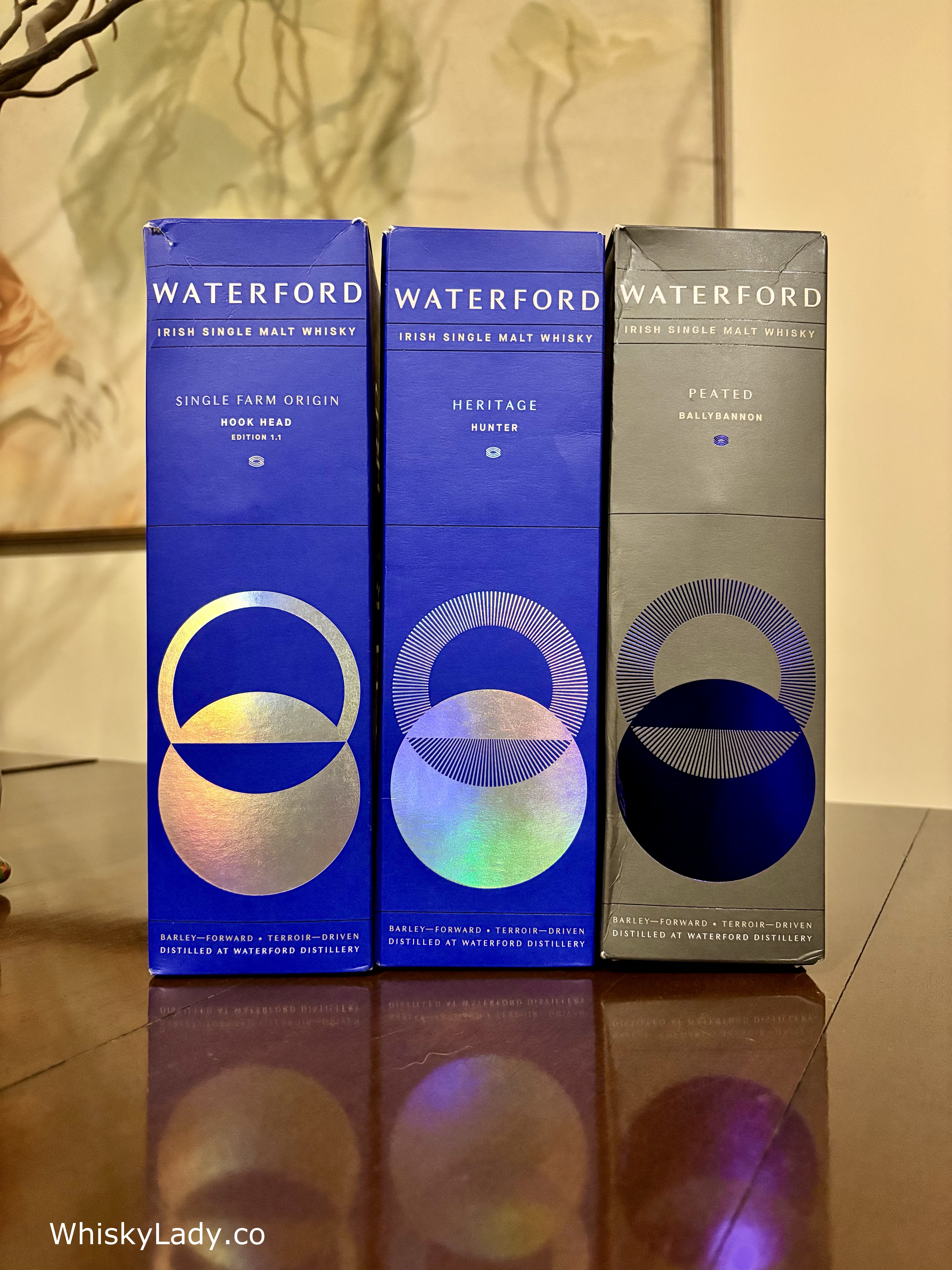
Even the boxes tell a story – signaling the type of whisky category to be explored. Would it be a Single Farm with clean firm lines? Or Arcadian Farm with a few lines joining to bring their different elements into a single experience? And where peat is in the mix, the box colour shifts to a smokey grey with black. There is a 3rd concept devoted to Cuvées which we did not experience.

Here is what the folks at Waterford have to say about their Single Farm Origin line “precision of place”:

Each Single Farm Origin is a compelling and intriguing whisky, but also an intellectual challenge to the whisky world’s status quo. Our radical, uncompromising philosophy allows inquisitive drinkers to join our exploration of the frontiers of authentic flavours, to search beyond conventions and to celebrate individuality.

One place, one farm, at a time.

And now what they share about their Arcadian Farm Origin line with a few options “the old ways – organic, biodynamic, peated & heritage”:

We ask what organic farming, or the ancient wisdom of biodynamics can offer to the intensity of barley’s flavour. Our curiosity leads us to discover then resurrect rare heritage grains, one variety at a time; and to experience the pungency of real Irish peat for the first time in generations in whisky. With these radical methods we ask the inquisitive, daring drinker to join us on our unorthodox journey towards the frontiers of authentic, uninhibited flavour.

What did we try?

The more I looked into the approach here, the more I recognized this is true whisky “geek” territory! Curious what the farm where the barley was grown sounds like? The exact location of where the barley was grown, who did what, and how? The organisms that live in the soil? Old wives’ tales converted into accumulated knowledge, combined with the cycles of the moons around the earth into science. The impact of how agro-business has “buggered the soil”, the importance of barley seeds from before 1967, and the role of air and composting? Enquiring minds will get answers to questions they didn’t even know to ask!

Curious about more Whisky Lady ramblings? Why not follow on: